Getting your products into Perplexity shopping
The way in is Perplexity's Merchant Program interest form, and the file to have ready is a Google-format product feed, the format PayPal's Store Sync, one of the routes in, says works well. As of 21 November 2026 Perplexity hasn't published its own field list, and buying inside Perplexity is open to US shoppers only.
Last verified 21 November 2026. A four minute read.
How to apply to Perplexity's Merchant Program
Fill in the Merchant Program interest form. It's five questions and takes a couple of minutes2. Perplexity launched the programme in November 2024, called it free, and said it emails next steps to merchants it takes on1.
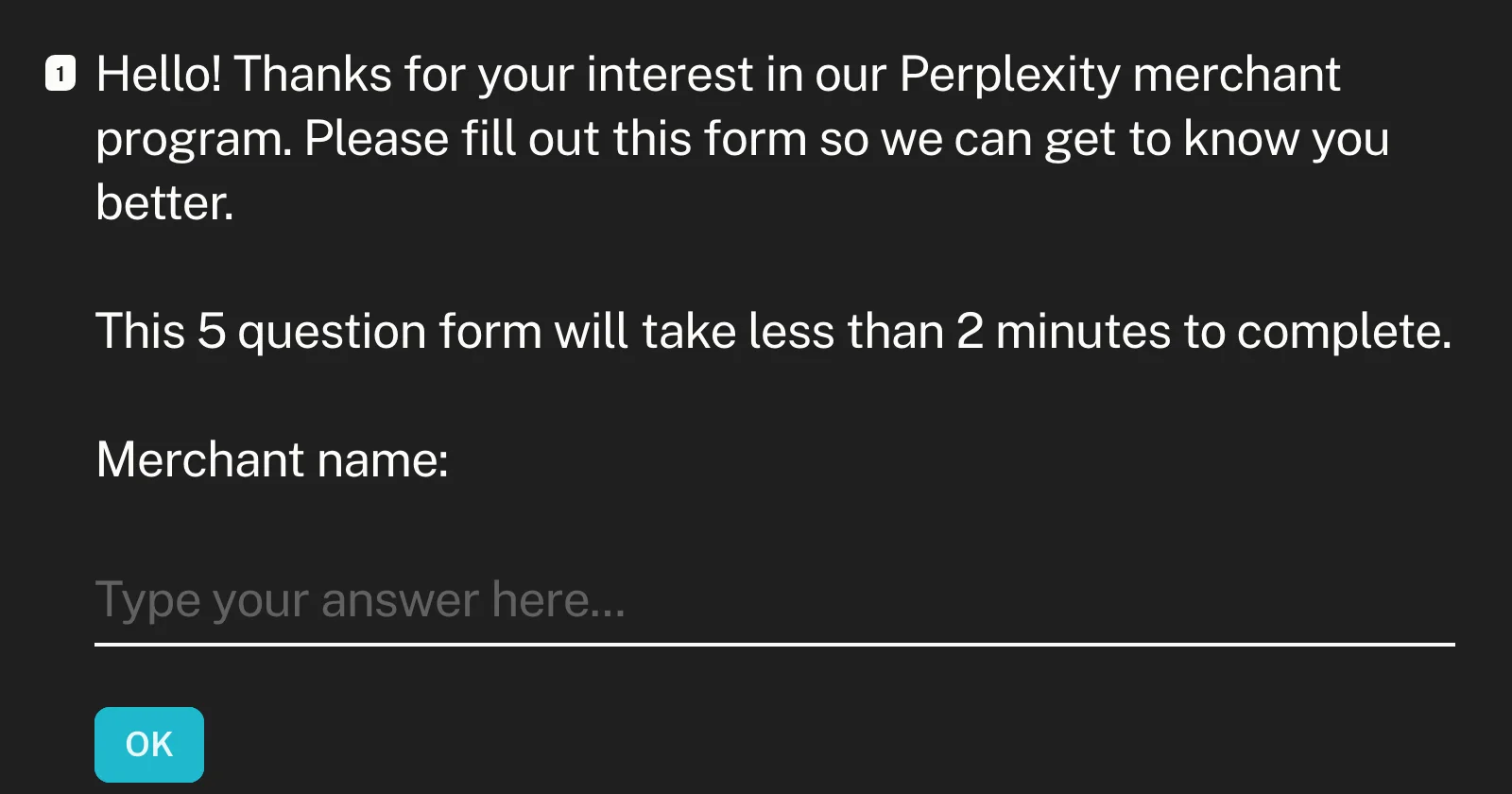
Perplexity has published no review time and no acceptance criteria, and it hasn't restated the 2024 benefits since. On 21 November perplexity.ai/merchants sent us to a sign-in for Perplexity Computer, not to a merchant portal10, so the form is still the door. Send it now; nothing happens until you do.
What feed does Perplexity take?
Plan on Google's format. Perplexity hasn't published a field list of its own, and we checked its blog, help centre, developer docs and merchant pages again on 21 November 2026. The one route that says what it wants points at the Google product data specification9.
PayPal's Store Sync, one of the routes into Perplexity, is the clearest about it.
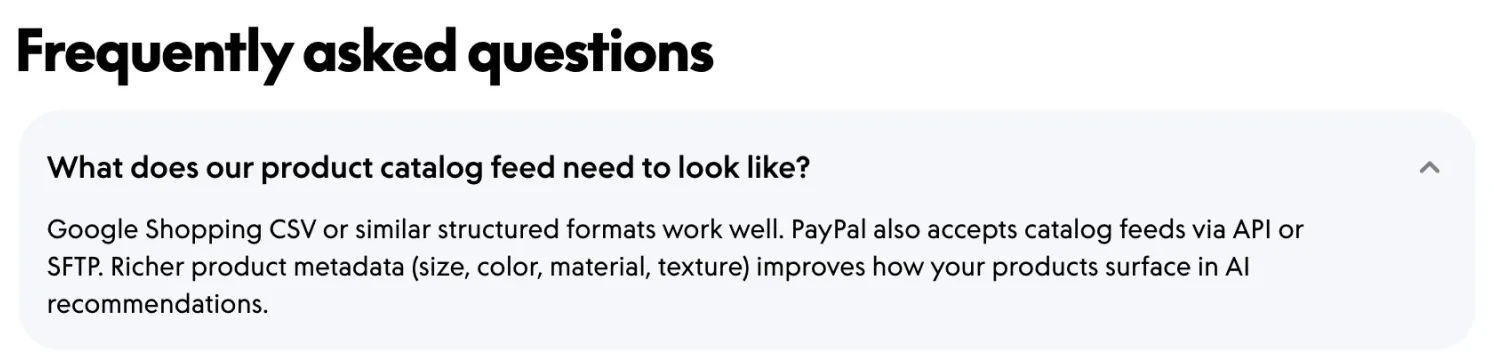
That's PayPal's guidance for its own service, and the page doesn't name Perplexity7. We'd still treat it as the spec, because it's the feed you probably already send Google.
Perplexity's Instant Buy help page adds the part that matters most. Listings with deeper details, such as availability, reviews, price and specifications, are more likely to be recommended, and advertisers can't pay to be listed3. So the optional fields are the ones to fill: colour, size, material, the measurements people ask about, and a title that says what the thing is.
The four ways in
As of 21 November 2026:
| Route | What it takes | Where it works |
|---|---|---|
| Merchant Program | The interest form; Perplexity emails next steps12 | Not stated by country |
| Shopify Catalog | A Shopify store; products go through agentic storefronts, on by default for eligible stores611 | Not stated by country |
| PayPal Store Sync | A request to PayPal, then your catalogue shared with PayPal; Perplexity names BigCommerce, Shopware and Wix merchants7813 | US and UK, says PayPal7 |
| Crawling | Product pages PerplexityBot can reach5 | Ordinary Perplexity answers everywhere |
They overlap. A Shopify store that takes PayPal can be in three at once.
The Shopify route is real and costs you nothing to switch on. It sends your catalogue as it sits, the same as every other Shopify store with the toggle on, so it gets you in without getting you picked. If your fabric is in the description and your "kids" is in a collection name, Perplexity's answer can't use either.
Crawling is the route you don't apply for, and the one you control least: Perplexity decides which pages to read and when. Why that leaves prices and stock out of date is in AI crawlers vs product feeds.
Who can buy inside Perplexity
Perplexity calls it Instant Buy. A product card carries the button, and the order goes straight to you to fulfil34. Perplexity says it's available to all users in the United States, works only with merchants compatible with its checkout, and covers a limited set of categories for now3. Its Instant Buy with PayPal page names Wayfair and Abercrombie & Fitch, and thousands of merchants on BigCommerce, Shopware and Wix13.
PayPal's Store Sync page says the service is available in the US and UK, with Germany and more markets on the way7. That's PayPal's reach across every AI platform it works with. If you sell only in the UK, Store Sync gets your catalogue to PayPal, but it won't make your products buyable in Perplexity yet.
Either way you stay the seller. Perplexity and PayPal both say you're the merchant of record and keep the customer relationship47. Shopify sellers should know their Perplexity orders run through PayPal and are managed there, not in the Shopify admin6.
Let PerplexityBot in
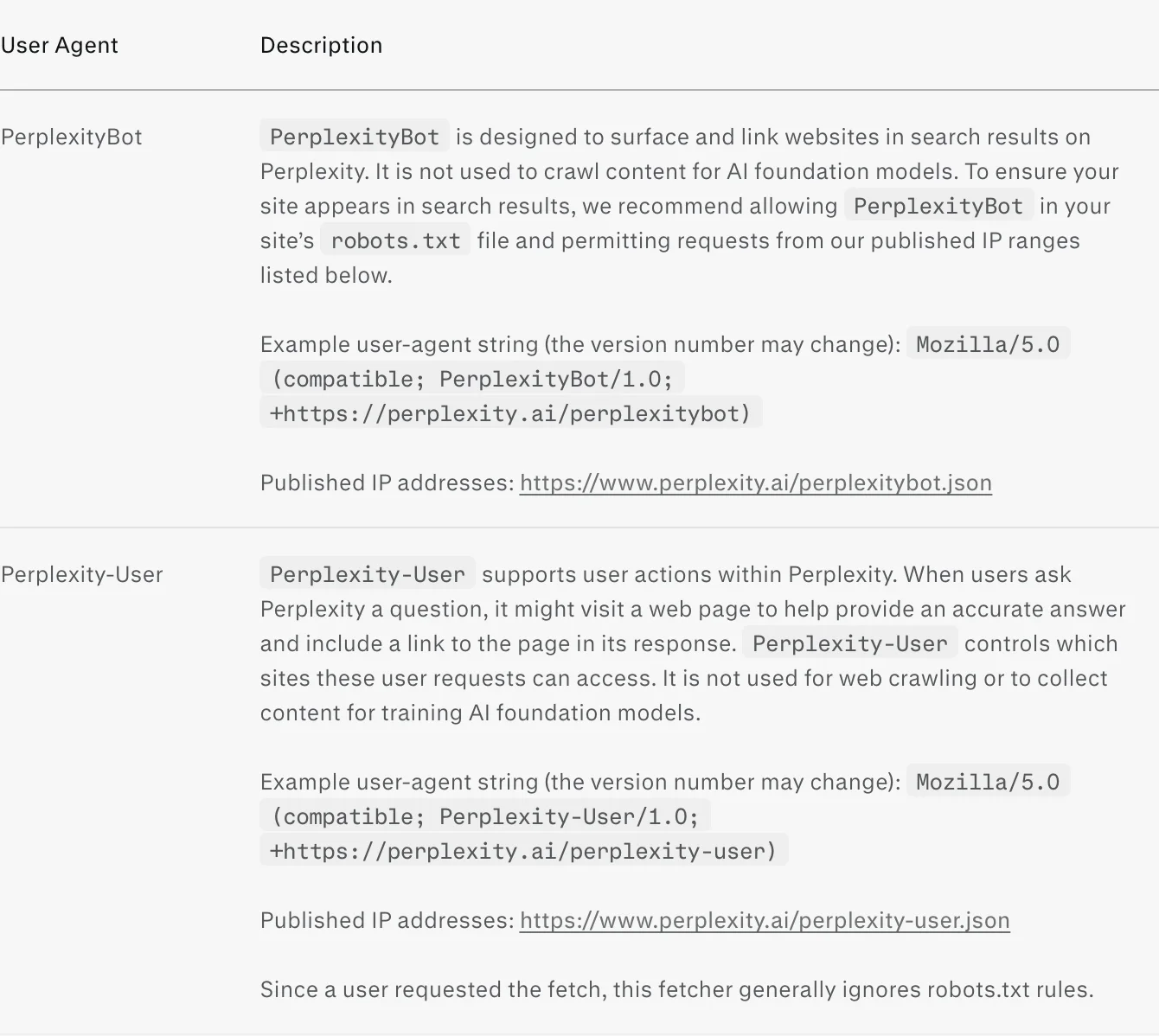
Perplexity documents two user agents. PerplexityBot crawls pages to surface and link them in answers, and isn't used to train models. Perplexity-User fetches a page when a person's question needs it, and generally ignores robots.txt because a person asked5.
- Open
yoursite.com/robots.txtand look for a rule that disallows PerplexityBot, or everything, on your product paths. - Ask whoever runs your CDN or firewall whether AI crawlers are blocked by default. A firewall can block PerplexityBot when robots.txt allows it.
- If you allow by IP, use the list at perplexity.ai/perplexitybot.json, and refresh it automatically5.
- Give a change up to 24 hours to take effect5.
Perplexity hasn't said which structured data it reads.
Schema.org Product markup with an Offer (price, currency, availability) is still worth having, because Google reads it too12.
When you can't see what Perplexity knows about you
With no Perplexity portal, you can't see what it holds on your products, and a crawler's copy of your price is only as fresh as its last visit. FeedWorks builds a Google-format feed from the same catalogue as your other channels, hosted at a URL or sent by SFTP, ready the day Perplexity or PayPal asks for a file.
Before that, it shows which products are missing the colour, size, material and specifications a recommendation leans on, and Aurora drafts rules to fill them from each product's own titles, descriptions and tags.
In early access, FeedWorks also asks shopper questions on Perplexity, ChatGPT, Gemini, Google AI Mode and Bing as a logged-out shopper, and shows which of your products get named and where the answer disagrees with your feed. Perplexity still decides what's shown.