Agentic commerce readiness: the six checks that matter
Getting ready for AI shopping assistants starts with a feed that updates as fast as your prices and stock, then rich attributes in both the required and optional fields. After that come a site the crawlers can read, shipping and returns set up, tracking, and a way to see how the assistants show you.
Last verified 21 November 2026. A six minute read.
What you're getting ready for
Ask ChatGPT which washable dog bed to buy for a large dog and it lists what to look for before it names a single product: size, orthopaedic foam, a removable cover, a waterproof liner, a non-slip base.
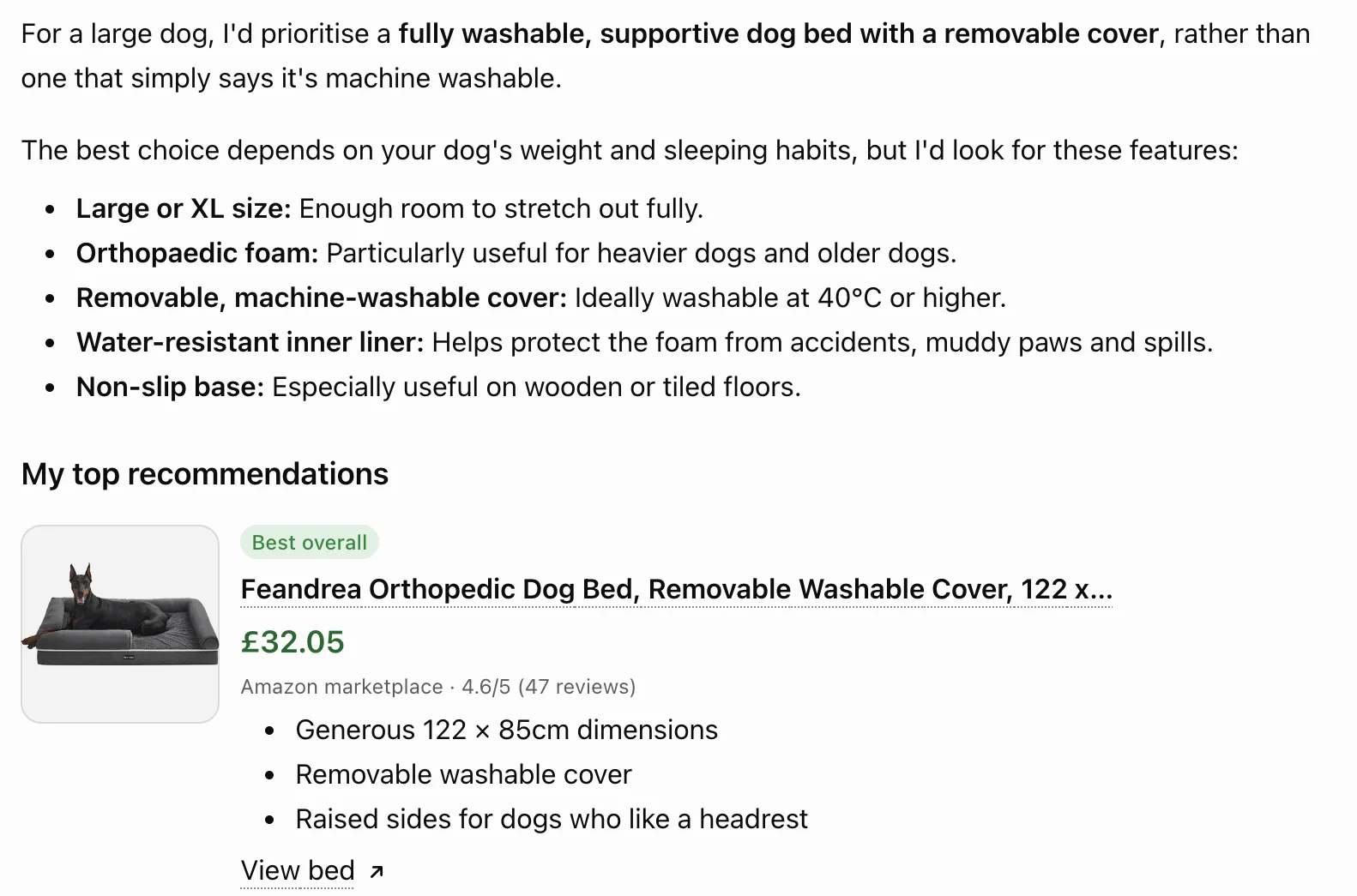
Every one of those criteria is a product attribute. An assistant can only pick your bed for a shopper who wants a waterproof liner if your data says it has one. Google's guide to its AI features says Merchant Center feeds can help products appear in AI responses1. So getting ready is mostly feed work, done more thoroughly than most feeds have ever needed.
The six checks, in order
Do them top to bottom. The first two decide whether the assistants have anything worth showing; the last two tell you whether it's working.
| Check | How to check | Done looks like |
|---|---|---|
| 1. A feed that updates itself | Find when your feed last refreshed, and how often it runs | Price and stock refreshed the same day, and hourly for anything that reprices or sells out |
| 2. Rich attributes, required and optional | Open 10 products from your biggest category in the file you send | Every required field filled, plus material, use, highlights and details |
| 3. A site the crawlers can read | Read robots.txt and test one product page |
Search crawlers allowed; price on the page, in its schema.org data and in the feed all agree |
| 4. Shipping and returns set up | Open Merchant Center's shipping and returns settings | A real shipping price and return window per market |
| 5. Tracking in place | Look for the AI Assistant channel in Google Analytics | Sales from assistants counted separately from other referrals |
| 6. Visibility measured | Open Merchant Center's AI performance report | Your share of voice written down before you change anything |
Keep the feed updating on its own
A feed built once a night is wrong by morning for any store that reprices or sells out during the day.
OpenAI's product feed spec puts it plainly: update the price when a sale starts or ends, and update availability when an item sells out or comes back2.
OpenAI rejects a whole row when availability is missing or isn't one of its 5 values2.
So the first check is the plumbing. How often does your feed rebuild, and does it push only what changed? Is the price coming from the system that knows it first, or from a nightly export of something else? If the answer involves a person uploading a file, start here.
Fill the optional attributes, not just the required ones
Every channel publishes required fields, and most feeds stop there. Required gets you accepted. Optional gets you matched.
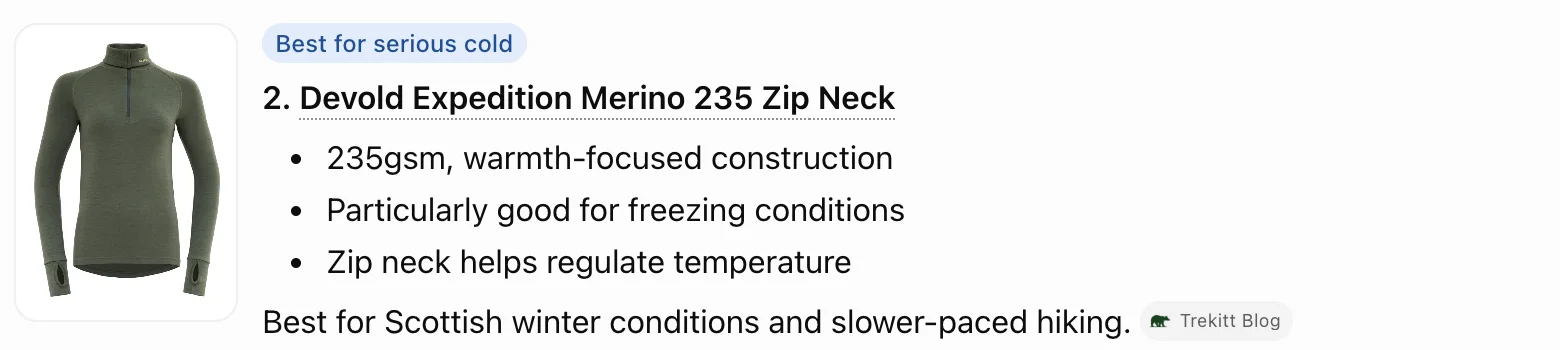
The assistants answer specific questions, and specific questions are answered by fields like material, age_group, product_highlight and product_detail.
Google added 6 optional conversational attributes for AI surfaces such as AI Mode, including questions and answers and the options that tell variants apart3.
They don't affect approval, so nobody makes you send them3.
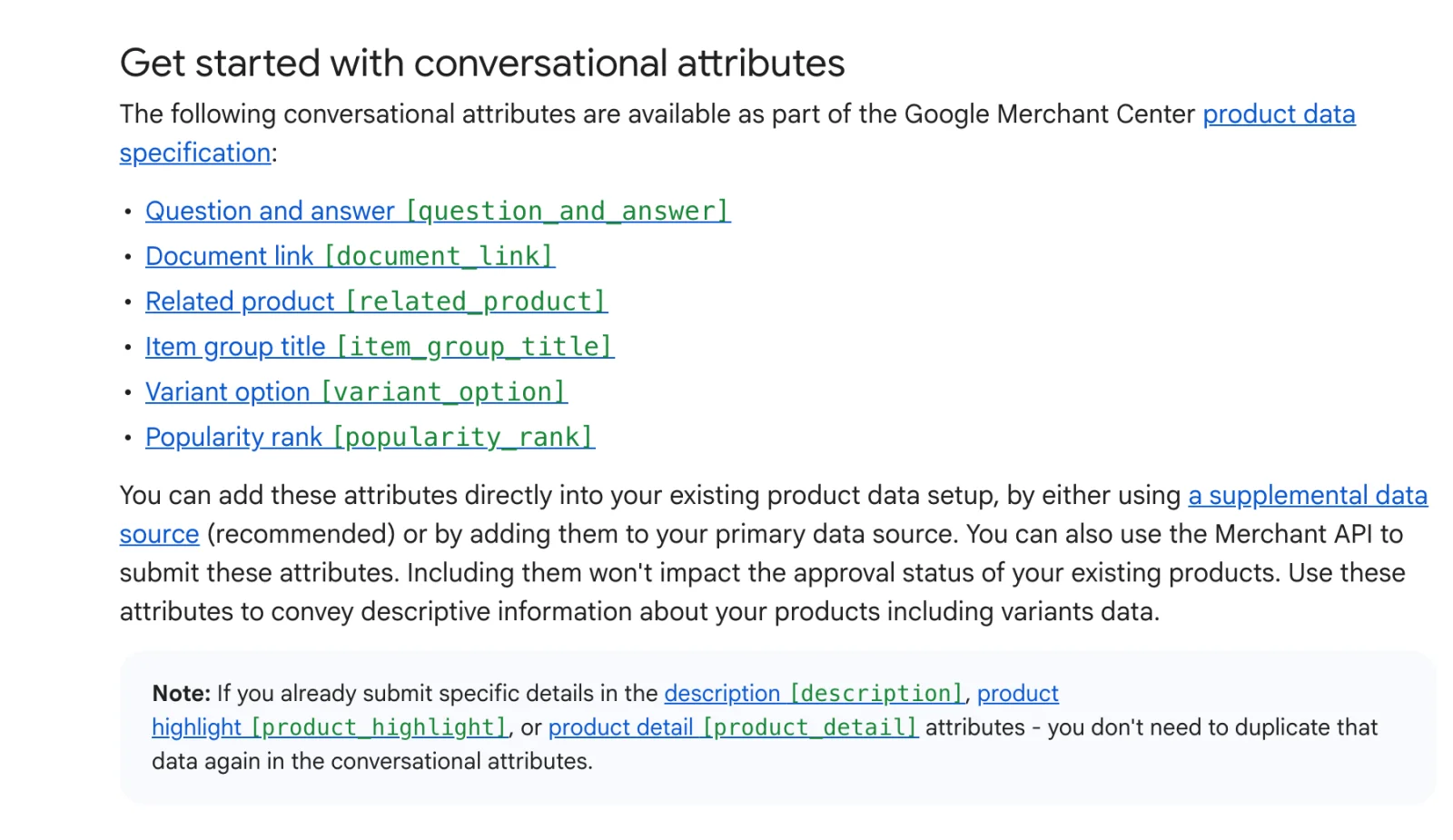
The data usually exists already, inside descriptions, tags and collections. Titles belong here too: a title that is only a style name, like "Aspen", matches nothing a shopper types. And keep the basics stable while you're in there: one ID per variant that never changes4, and a link that opens that variant5. The detail is in Google's conversational attributes.
Set your site up for the bots
This check belongs to whoever runs the website, and starts with robots.txt.
| Crawler | Block it and |
|---|---|
| OAI-SearchBot | Your site isn't shown in ChatGPT search answers6 |
| GPTBot | ChatGPT search is unaffected; it governs training6 |
| PerplexityBot | Perplexity can't surface and link your pages7 |
| Googlebot | Your pages can't be indexed, and Google's AI features only show indexed pages1 |
In our experience a rule pasted in to block "AI bots" often catches the search crawlers too. Read the file rather than assuming.
Then check that the page tells the same story as the feed.
Google compares three things: the price in your feed, the price on the landing page, and the price in the page's schema.org Offer markup816.
A price written in by JavaScript after the page loads doesn't count, because Googlebot reads what the server sends8.
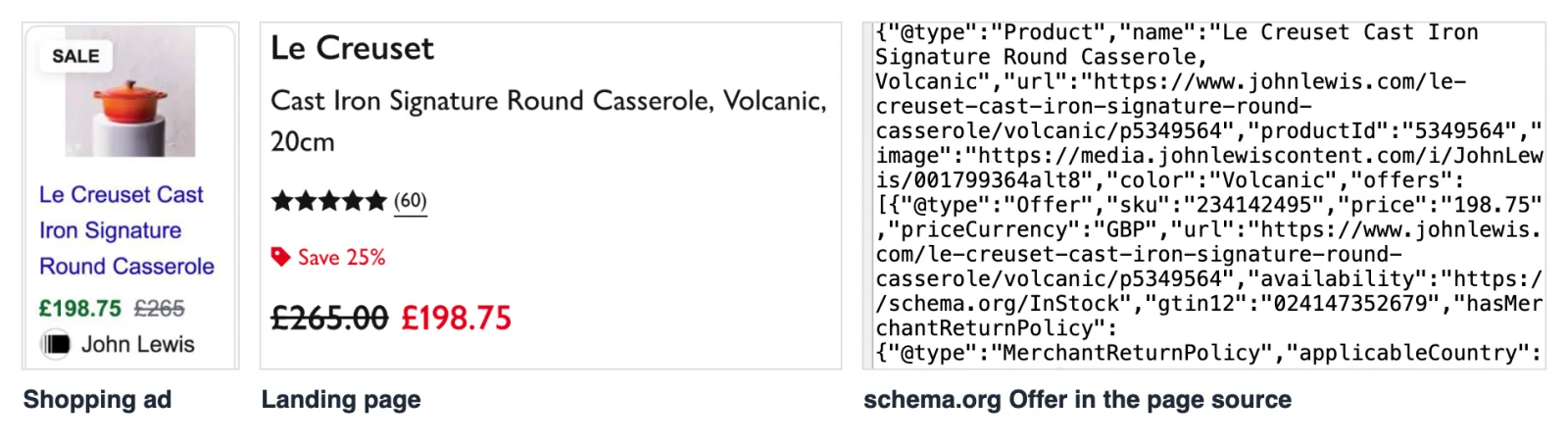
Google warns that prices which keep disagreeing may lead to an account suspension8. The causes and fixes are in mismatched value: price.
Set up shipping and returns
Shoppers ask about delivery and returns before they buy, and the assistants answer from your data. Google takes shipping from Merchant Center's shipping settings or the feed, per country9.
OpenAI makes seller_name required on every row, and an empty shipping_price there means unknown, not free2.
We'd add accepts_returns and return_deadline_in_days now, because the work is small2.
Microsoft asks for a return policy and a support contact in Microsoft Merchant Center to use Copilot Checkout10.
Make sure you can track it
A sale you can't attribute is a channel you'll stop investing in. Google Analytics now has an AI Assistant channel in its default channel group, covering visits from ChatGPT, Gemini, Copilot and others, though not AI Overviews or AI Mode, which stay in Organic Search11.
Check your reports use it, and that your conversion tags fire on the pages assistants send people to. We'd also tag the links in each AI feed with their own UTM source, so a click from a ChatGPT product card is told apart from a ChatGPT citation.
See how the assistants show you
The last check is the one most stores skip: what do the assistants actually say about your products, to whom, and how much of the answer is yours?
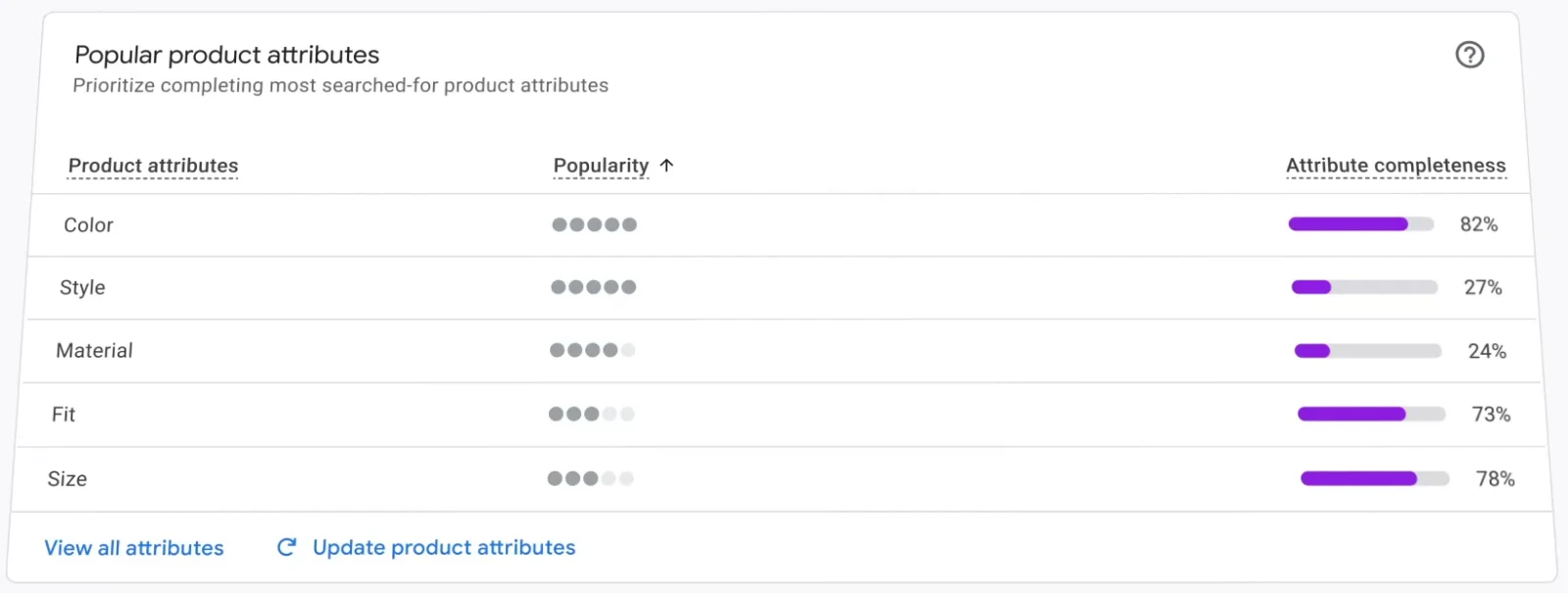
Merchant Center's AI performance report shows your share of voice against competitors in Google's AI answers, the query types you show up for, and popular attributes missing from your data12. It covers English queries for accounts in Australia, Canada, India, New Zealand and the US12.
Bing Webmaster Tools reports Copilot citations for your pages13. We found no merchant report from OpenAI, Perplexity or Meta on 21 November 2026.
Write down what you can see today, before you change anything. The rest is covered in AI performance insights.
What to leave until later
| Skip | Why | Look again when |
|---|---|---|
| Agentic checkout | Google's checkout in AI Mode and Gemini is for select merchants, for products eligible in the US, Canada and Australia14. Copilot Checkout is for English-language merchants selling to US buyers10. ChatGPT sends every sale to your own site15 | A programme opens to you, in a country you sell in |
llms.txt and special markup for Google |
Google says its AI features need no new machine-readable files1 | Google says otherwise |
The protocols behind checkout are explained in ACP vs UCP vs MCP.
When the checklist outgrows a spreadsheet
None of these checks stays done, because the catalogue changes every day and the store's own connectors send the data as it sits.
FeedWorks refreshes as often as hourly, pushes only the products that changed to Merchant Center by API, and can layer a fast price and stock source over your main catalogue. It pulls attributes out of descriptions, tags and collections into the required and optional fields each channel reads, and scores every product against each channel, Google's conversational attributes included. Aurora drafts the fixes for you to approve.
It also brings in Google Ads, GA4 and Merchant Center results per product, and AI Visibility, in early access, shows how ChatGPT, Gemini, Google AI Mode, Perplexity and Bing describe your products and where the answer disagrees with your feed.