ACP, UCP and MCP: what each one is, and what it asks of you
ACP is behind shopping in ChatGPT, and UCP is behind checkout in Google AI Mode, Gemini and Copilot; for most merchants both come down to a good product feed and a few policy fields. MCP is how an agent such as Claude or ChatGPT connects to the systems you already run, from the ERP to the feed, so one agent can work across all of them.
Last verified 21 November 2026. A six minute read.
What ACP, UCP and MCP each do
ACP, the Agentic Commerce Protocol, and UCP, the Universal Commerce Protocol, are about selling inside an AI assistant. MCP, the Model Context Protocol, is about your own work: it connects an agent to the software your business runs on. A protocol is an agreed way for two pieces of software to talk, and most merchants never write a line of one; their platform does. What you own is the product data they carry.
| Where you meet it | What it asks of you | When | |
|---|---|---|---|
| ACP | Shopping in ChatGPT, US only. The sale finishes on your site4 | A ChatGPT product feed, sent by you or your platform | Now, if you sell to US shoppers |
| UCP | A Buy button in Google AI Mode and Gemini, and Copilot Checkout912 | A clean Merchant Center feed, then checkout eligibility once you're accepted | Feed now. Checkout when you're accepted |
| MCP | In your own agent, never in front of shoppers | Connect the systems you run to Claude, ChatGPT or another agent | Whenever it saves your team time |
The assistant picks the shopping protocol, not you. ChatGPT uses ACP. Google and Microsoft use UCP4812. Sell through both and you'll meet both, mostly through your platform.
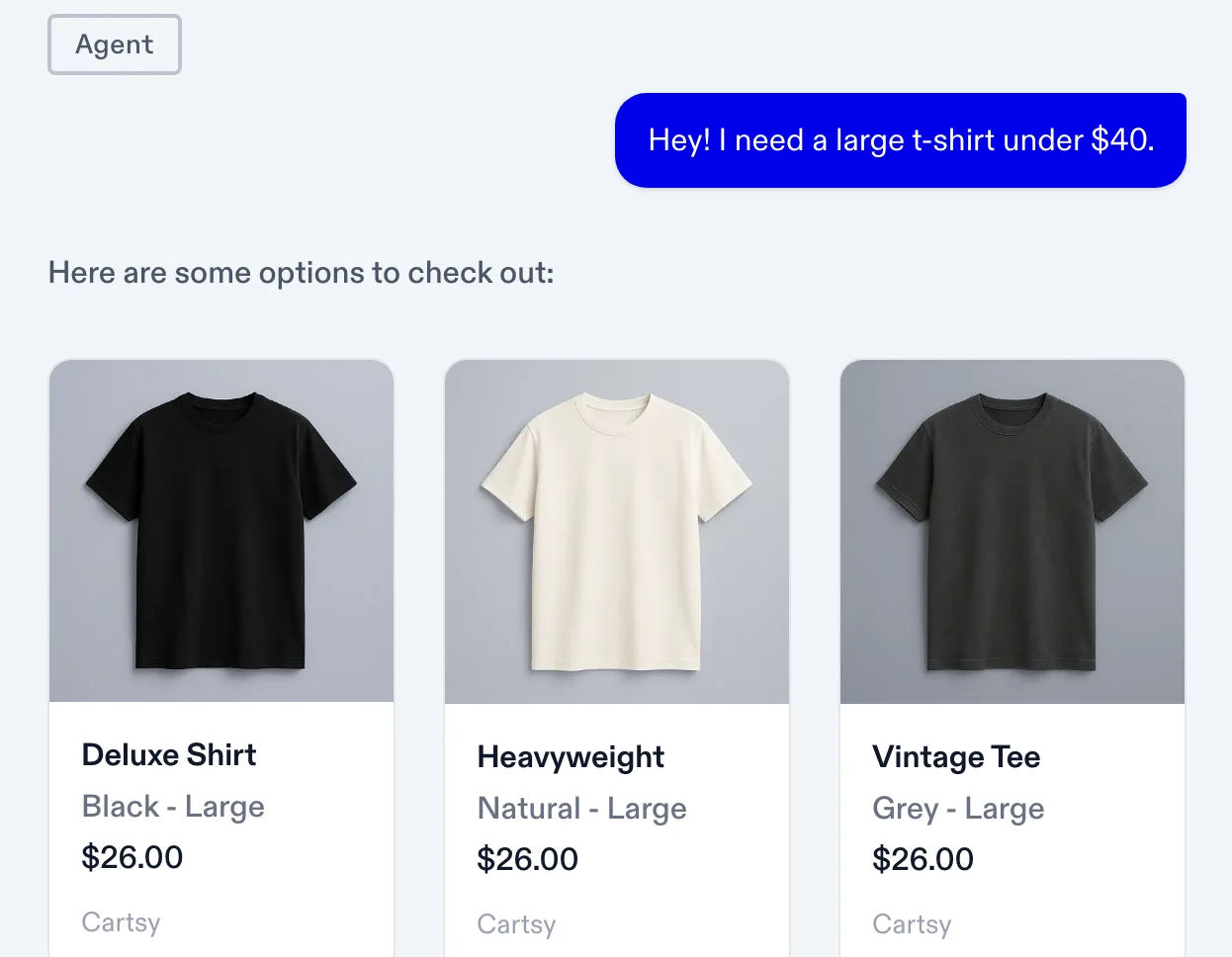
ACP: how ChatGPT reads your products
ACP covers checkout sessions, passing a payment token safely and order updates after the sale3. Its repository names OpenAI and Stripe as founding maintainers, marks the spec as beta, and lists 2026-04-17 as the latest version2.
OpenAI has moved away from a standalone Instant Checkout in ChatGPT. Shoppers find and compare products there, then buy on your own site or app, and OpenAI charges no fee on those sales4. It calls ACP the infrastructure behind shopping in ChatGPT, supporting discovery today, with the rest of the journey to follow4.
So, as of November 2026, ACP asks one thing of a merchant: a product feed.
Shopify and Etsy sellers are already in, with no application, and everyone else applies through OpenAI's merchant form4.
The checkout fields in OpenAI's feed spec, is_eligible_checkout, seller_privacy_policy and seller_tos, only matter where checkout is turned on for your integration5.
seller_name is required on every row regardless5.
The ChatGPT feed guide has the full field list.
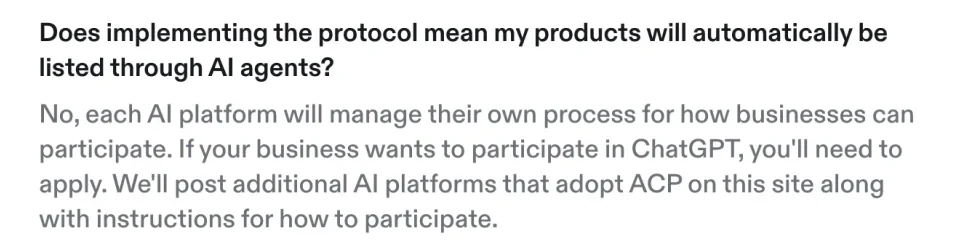
The founders are still unsettled: Stripe's documentation says ACP was created by Stripe, OpenAI and Meta, while the ACP site and repository name only Stripe and OpenAI, all checked on 21 November 2026123.
UCP: the protocol behind Google's Buy button
UCP covers catalogue search, cart, identity linking, checkout and order management7. Google announced it on 11 January 2026 with Shopify, Etsy, Wayfair, Target and Walmart6. As of 21 November 2026 ucp.dev also lists Amazon, Microsoft, Meta, Salesforce and Stripe among its shopping co-developers7.
This is the one with a live Buy button. In AI Mode and Gemini, select merchants sell inside the answer, the shopper pays with Google Pay, and you stay the seller of record9. Google's help page covers products eligible in the US, Canada and Australia, through an interest form9.
Merchant Center onboarding is rolling out in the US first, with Australia and Canada in 202717. Canadian shoppers can already buy from a few named retailers and select Shopify merchants10.
Microsoft calls UCP a layer on top of your Merchant Center feed: the feed gets you found, UCP handles the checkout12. As of 21 November 2026 Copilot Checkout is open to English-language merchants selling to US buyers, and Shopify merchants are enrolled automatically12.
On Google, UCP asks your feed for a native_commerce checkout flag on each product you want to sell, variant_option on products with variants, and a return policy and support contact in Merchant Center11.
The UCP checkout guide goes field by field.
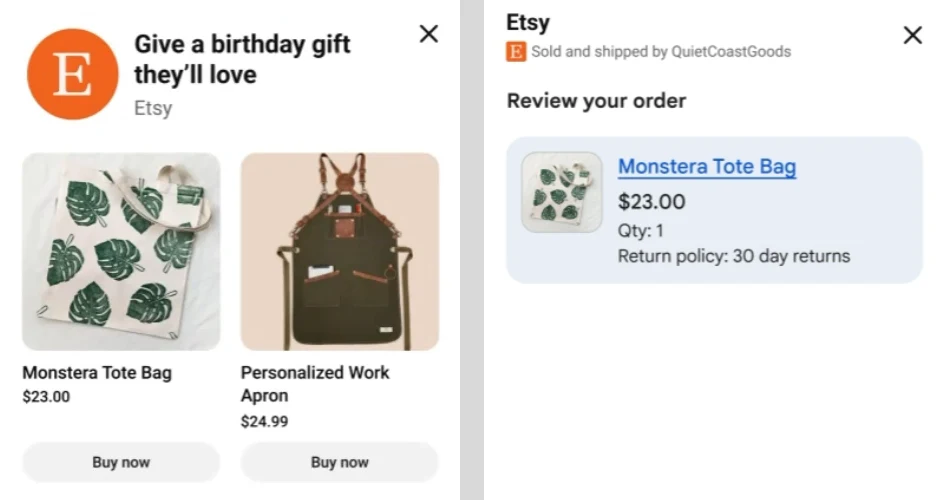
The checkout itself needs a Google Pay and Wallet Console account and a technical integration9. That's a job for your platform, your payments provider or your developers.
MCP: one agent connected to every system you run
MCP is an open standard that lets AI apps such as Claude or ChatGPT connect to outside systems, read what's there and do work in them14. Anthropic created it and gave it to the Agentic AI Foundation, part of the Linux Foundation, on 9 December 202515.
It touches shopping in one narrow place: UCP can carry its messages over MCP, a choice for whoever builds your checkout7. The bigger use is inside your business.
Most of the systems a retailer runs now offer an MCP server. As of 21 November 2026 that includes the ERP (NetSuite), the PIM (Akeneo), the CRM (HubSpot), customer engagement (Klaviyo), the store (Shopify's own connectors) and Google's ads and analytics tools19202324252122.
The OMS is often the store platform itself: Shopify's connectors manage the store, and WooCommerce's MCP reads orders and updates their status2526. Each one is a door your agent can open with your permission.
Connect several to one agent and it carries the context between them. It knows which lines carry the best margin from the ERP, which ones are overstocked, which ones Google Ads spends on and which ones customers send back. Ask it where the ad money is going on products you can't restock, and it can answer from four systems in one reply, where today that's four logins and a spreadsheet.
The ads half has a catch. Google Ads and the AI channels decide what to show from your product feed, so the agent's best idea only reaches a shopper if something can change the data before it's sent.
The Google Analytics MCP server is read-only, and the Google Ads one can't touch campaigns, bids or budgets2122. Google's Merchant Center MCP is an experimental alpha that reads product data and can do little more than create a data source16. That's why the feed platform sits on the map between the store and the channels.
Picking between ACP and UCP
You follow the assistant, so there's nothing to pick. On Shopify, agentic storefronts send your catalogue to ChatGPT, Copilot, AI Mode and Gemini, and the setting is on by default, with new channels added automatically1318. That's a real route, and it costs nothing to keep.
It also sends your data as it sits, the same as every other Shopify store, so it gives you no edge. The colour, material and fit that assistants match on usually sit inside descriptions, tags and collections, not in their own fields. Titles aren't tuned for any channel, and what ChatGPT wants differs from what Google wants.
Neither protocol fills a single one of those fields for you. They carry whatever your feed sends, gaps included.
We'd skip building your own ACP or UCP endpoint this year unless a channel has already said yes to you. Spend that time on the data both protocols carry.
If you want your agent to reach the feed too
Most of the map above is already possible. The step that's usually missing is the one that changes what Google, Meta and the AI channels receive.
FeedWorks, the first end-to-end agentic feed platform, has an MCP server. Connect Claude or another MCP agent and it can read your feed, find the products a channel will reject, and draft the rule that fixes them, with a person approving where it matters. As of November 2026 it's the only feed platform with a mature, agentic MCP.
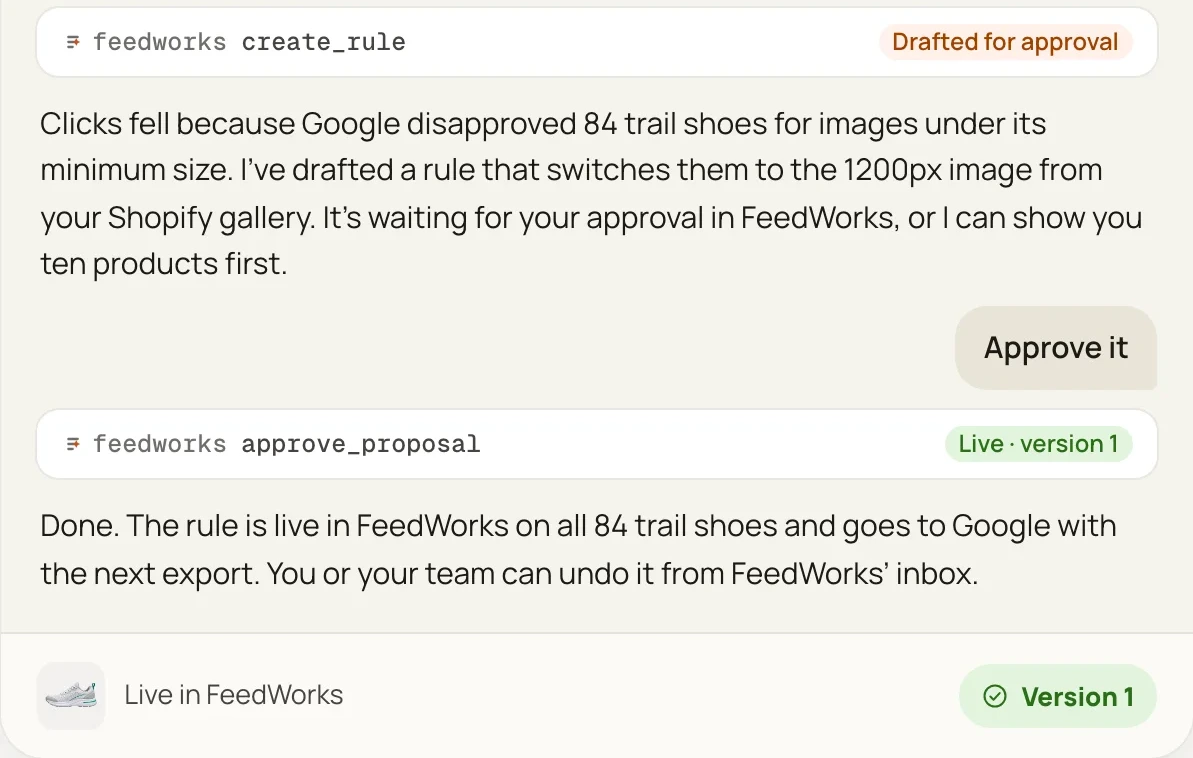
For ACP and UCP it stays on the feed side: it builds the ChatGPT, Copilot and Perplexity files from the catalogue you already send to Google. The checkout build is your platform's job, and the listing decision is the programme's.