The ChatGPT product feed spec, field by field
OpenAI's feed spec requires 11 fields on every row, including seller_name, target_countries and store_country, which a Google feed doesn't carry. A missing or unrecognised availability value rejects the row, and the optional fields for variants, reviews, returns and shipping are what ChatGPT has to answer a detailed question with.
Last verified 21 November 2026. A five minute read.
A question ChatGPT answers from product data
Ask ChatGPT for waterproof hiking boots for wide feet and look at the name of its top pick.
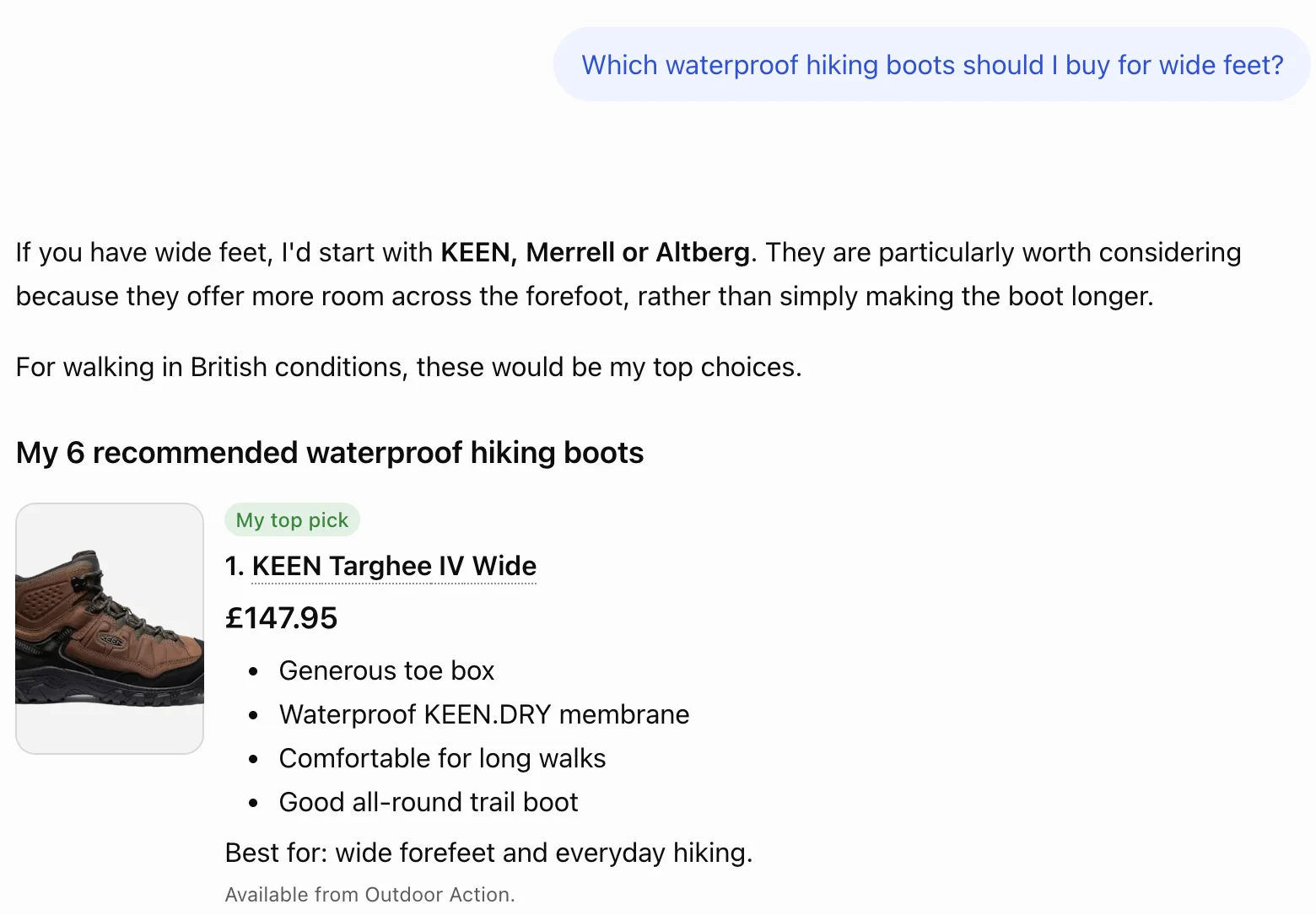
The product that says "Wide" in its name came first. We can't say that's why, but OpenAI says ChatGPT picks products from structured data such as price and description, supplied by first-party and third-party providers1. A feed is how you become a first-party provider.
This page is the spec, from OpenAI's product feed schema2, read on 21 November 2026. Access, Business Hub and the merchant form are in our ChatGPT product feed guide.
What ChatGPT does with it
OpenAI says product results aren't ads, and that it ranks merchants on availability, price, quality and whether the seller makes the product or is its main seller1. Review summaries are written by the model from public websites, and OpenAI doesn't verify them1.
That leaves the feed carrying the facts ChatGPT can't make up for you: the exact variant, the price today, whether it's in stock, whether it goes back free. The required fields get a product considered. The optional ones are what lets it match "wide fit, waterproof, under 150 pounds, free returns".
If you're on Shopify or Etsy
OpenAI's merchant page says Shopify and Etsy catalogues are already integrated, with no setup or application4. That route sends the store's data as it sits, in the same shape as every other store on the platform. Facts that sit in a description or a tag stay there, and a title written for the store page stays as written.
The optional fields further down this page are the ones a route like that leaves to chance.
Where a Google feed falls short
| ChatGPT | What changes | |
|---|---|---|
id |
item_id |
Keep the same value |
link, image_link |
url, image_url |
Rename |
preorder |
pre_order |
Rewrite the value, or the row goes |
item_group_id |
group_id |
Add listing_has_variations and variant_dict |
google_product_category |
product_category |
A readable path |
| Set per account | seller_name, target_countries, store_country |
Add to every row |
question_and_answer |
Not supported | Drop it |
Keep item_id equal to your Google id and a product stays recognisably the same product across channels.
The 11 required fields
| Field | Rule |
|---|---|
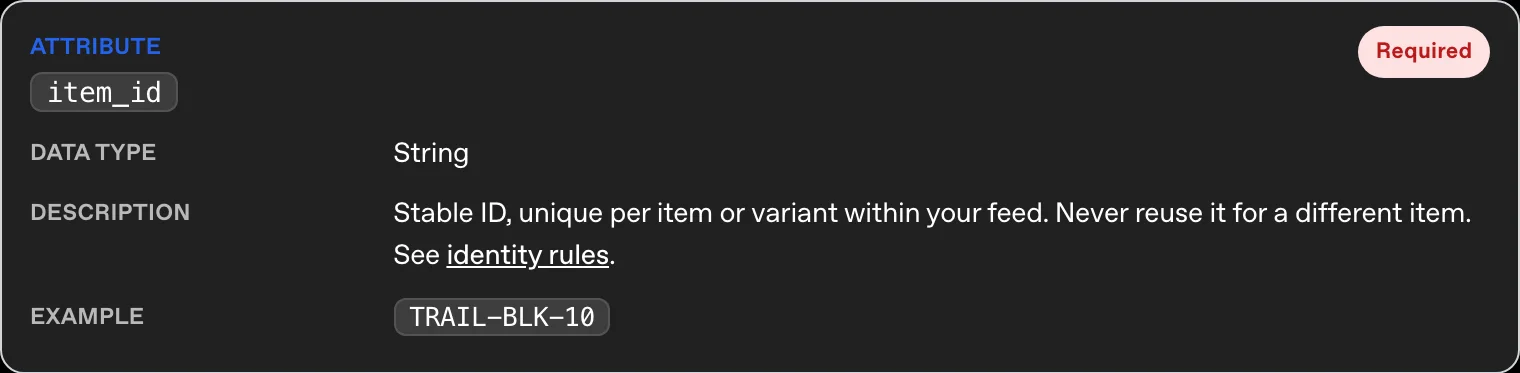
item_id |
Stable, unique per variant, never reused for another product |
title |
About 150 characters, variant included |
description |
About 5,000 characters, plain text |
url |
Absolute, public, HTTPS preferred |
brand |
As shown on the product page |
seller_name |
Who sells it, on every row |
image_url |
A direct, public image link |
availability |
in_stock, out_of_stock, pre_order, backorder or unknown |
price |
79.99 USD: positive, no thousands separator, uppercase code |
target_countries |
Uppercase codes, ["US"] for standard uploads |
store_country |
US for standard uploads |
OpenAI gives the title and description lengths as guidance, not hard limits2. The hard rule is availability: if it's missing, empty or a value OpenAI doesn't recognise, the row is rejected2. OpenAI also warns that passing upload doesn't mean every bad value was caught2.
The optional fields that answer questions
A shopper asking ChatGPT has usually said more than a search box gets: the size, the fit, the budget, whether it can go back. These are the fields that answer, in OpenAI's groups2.
Variants
group_id, listing_has_variations and variant_dict work together.
group_id must differ from item_id, and variant_dict is ignored unless listing_has_variations is true2.
Product attributes
| Field | Rule |
|---|---|
gtin |
Exactly 8, 12, 13 or 14 digits, with a valid check digit |
mpn |
Sent with brand |
product_category |
A path from broad to specific, split by > |
color, size, material |
Free text |
gender |
male, female or unisex |
age_group |
newborn, infant, toddler, kids or adult |
condition |
Always send it for used or refurbished |
weight, dimensions |
Positive numbers, with a unit |
additional_image_urls |
A list; bad URLs are dropped, not the row |
sale_price |
Lower than price, same currency |
Reviews, returns and shipping
review_count and star_rating describe the product, not the store, and a rating needs a positive review count2.
accepts_returns and return_deadline_in_days answer "can I send it back".
A returns policy URL on its own doesn't set accepts_returns2.
shipping_price left out means unknown to ChatGPT, not free2.
The eligibility switches
Three booleans decide where a row can appear2.
is_eligible_search defaults to true, and setting it to false also turns off checkout.
is_ads_eligible defaults to off unless a feed-level default says otherwise, which matters if the same file feeds ChatGPT ads.
is_eligible_checkout needs search eligibility and a checkout-enabled integration, plus seller_privacy_policy and seller_tos links.
Sending it to OpenAI
OpenAI's examples are JSONL, and the schema covers CSV and TSV, with JSON values serialised into cells2. Feeds arrive as full snapshots, by manual upload, a hosted URL or SFTP3. OpenAI asks you to update price and availability when they change2; a sale end date in the feed doesn't schedule anything.
When a Google feed is the starting point
In our experience, most ChatGPT feeds begin as a Merchant Center export with three columns added.
The renames are quick; the gaps aren't: no returns data, no review counts, no seller_name.
FeedWorks builds the ChatGPT feed from the same catalogue as your Google feed, with the renames and value changes as standing rules, and checks GTIN check digits before the feed goes out. To see how ChatGPT describes your products once they're in, AI Visibility is in early access.