The Google Merchant Center product feed spec
Google requires an ID, title, description, link, image, price, availability and brand on every product, plus GTIN, apparel and shipping fields where they apply. The optional fields, such as product highlights and question and answer, are what AI Mode and Gemini match a detailed question against.
Last verified 21 November 2026. A five minute read.
What Google does with your fields
Search Google Shopping for wide-fit waterproof walking boots and read the ads that come back.
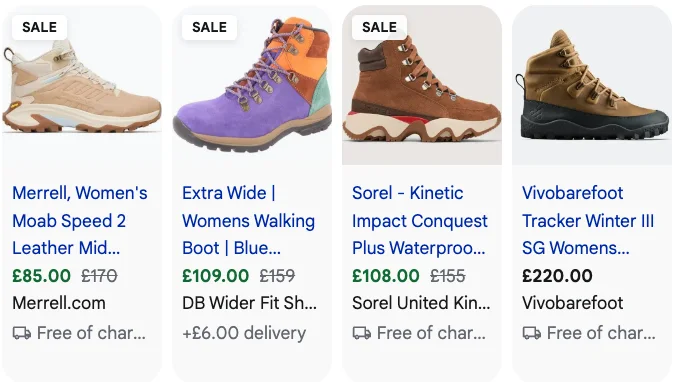
The shopper asked for wide fit, and most of these titles never get that far on screen. Whatever Google matched them on sits in the rest of the title and the fields behind it, which is the part of the data you control.
The official spec is the Google Merchant Center product data specification1. Keep it open while you read this. It's the spec the other channels copy, so getting Google right gets you most of the way to Microsoft, Meta and ChatGPT.
What AI Mode and Gemini read
There's no separate feed for Google AI Mode. Google's guidance for its AI features names Merchant Center feeds as the way to make products visible in AI responses6.
A long question carries detail a 70-character title can't: wide fit, vegan leather, fits a size 42. What's left to match it against is the full 150-character title and the optional fields beneath it. Google says its conversational attributes help AI systems understand a product's specific nuances, on surfaces such as AI Mode7.
A feed that sends only the required fields can still be shown, but it gives Google less to match than the feed beside it.
The fields Google requires
Read as of 21 November 20261. "Depends" means Google requires it only in the case named.
| Field | Status | The limit or rule that catches people out |
|---|---|---|
id |
Required | 50 characters. Change it and the product loses its history |
title |
Required | 150 characters, though shoppers usually notice only the first 708 |
description |
Required | 5,000 characters |
link |
Required | Must open the page for that exact variant |
image_link |
Required | 500 by 500 pixels minimum, enforced from 31 January 2027 |
price |
Required | Number plus ISO 4217 code. Without tax in the US and Canada; with VAT or GST everywhere else |
availability |
Required | in_stock, out_of_stock, preorder or backorder, with underscores |
brand |
Required for new products | 70 characters |
gtin |
Depends: if the maker assigned one | Valid GS1 number, 14 digits at most |
mpn |
Depends: only if there's no GTIN | 70 characters |
condition |
Depends: used or refurbished | new, refurbished or used |
item_group_id |
Depends: variants in 6 countries | 50 characters |
color, size, gender, age_group |
Depends: apparel in 6 countries | color holds 100 characters, 40 per colour |
shipping |
Depends: 21 countries | Or set shipping in your account instead |
The 6 apparel and variant countries are Brazil, France, Germany, Japan, the UK and the US1. Shipping is required in 21 countries, the UK, US, Germany, France and Australia among them1. You can send it per product or set it once in Merchant Center.
The optional fields worth filling
Most feeds stop at the table above. That's the minimum Google will show, and it's also what every competitor sends.
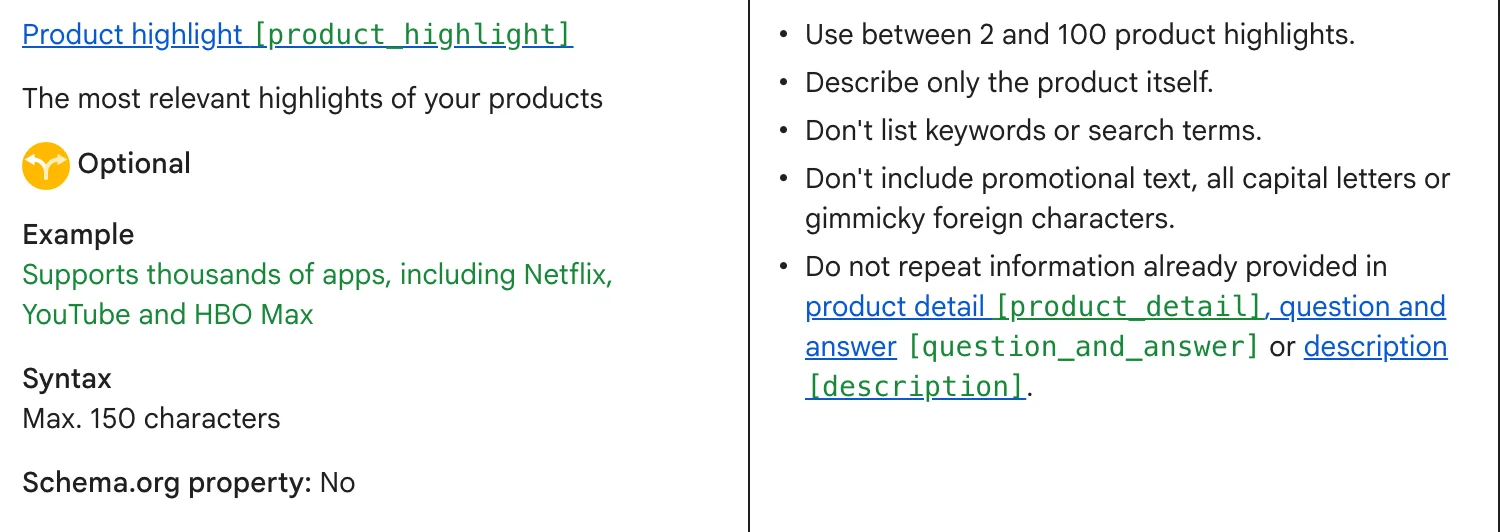
These are the ones we'd fill first, with Google's limits1:
| Field | Limit | Why it earns its place |
|---|---|---|
product_highlight |
2 to 100, 150 characters each | Short facts an answer can quote |
product_detail |
Up to 100 name and value pairs | Specs in a form a filter can read |
question_and_answer |
30 pairs, 1,000 characters each, 10,000 in all | The questions shoppers actually type |
item_group_title |
150 characters | A clean name for the whole family of variants |
variant_option |
30 values, 250 characters per name or value | What differs between variants |
material, pattern |
200 and 100 characters | Often the exact words in a long query |
additional_image_link |
Up to 10 | More angles, more chances on visual surfaces |
product_type |
750 characters | Your own category path, which you can bid on |
custom_label_0 to 4 |
100 characters, 1,000 values per label | Campaign structure, invisible to shoppers |
question_and_answer, item_group_title, variant_option, related_product, document_link and popularity_rank are the newer conversational attributes.
We cover how to write them in conversational attributes.
Getting products into Merchant Center
A file is tab-separated text or XML, up to 4 GB2.
Upload it, or host it at an http, https or sftp address Google fetches on a schedule2.
Google Sheets and the Merchant API are the other routes. The old Content API for Shopping reached its sunset on 18 August 20263, so anything still built on it needs moving.
Products expire 30 days after their last update4. In practice you want a daily fetch at least, and hourly for price and stock if they move during the day.
On Shopify, the Google & YouTube app syncs your products to Merchant Center5. It sends what the store holds, the same way it does for every other Shopify store. Highlights, materials and answers that live in your descriptions and tags stay there, so the optional half of this page goes unsent.
How Google differs from the other channels
Google sets the baseline, so the differences are mostly other people's.
- Google is the only one of the six with country-specific apparel rules. Only Google and Microsoft require a GTIN, and only when the maker assigned one.
- Its 50-character
idis the shortest limit with Microsoft's, so an ID that fits Google fits everywhere. - Its availability values use underscores. Meta, Microsoft, TikTok and Pinterest use spaces, and ChatGPT spells pre-order
pre_order.
The specs side by side has every channel in one table.
When the optional half never gets filled
Usually it's because the facts exist, but in the wrong place: a description paragraph, a tag, a collection name. Moving them into fields by hand for a few thousand products doesn't happen.
FeedWorks pulls those values out of descriptions, tags and collections into the fields Google reads, as rules that keep working on every new product. It shows required and recommended fields per channel, Google's conversational attributes included, so you can see what's missing before Google tells you.
Titles get the same treatment: a rule can put brand, colour and size into every title in the catalogue. Aurora drafts the rules, you approve them, and the result goes to Merchant Center by API.