The Microsoft Merchant Center product feed spec
Microsoft Merchant Center requires id, title, description, link, image_link and price, plus brand, GTIN and MPN where the maker assigned them. Availability and condition are optional, and that's the trap: leave them blank and Microsoft assumes every product is new and in stock.
Last verified 21 November 2026. A five minute read.
Most Microsoft feeds start as a Google import
Microsoft makes it easy to skip this page. Its Google import tool copies your Google Merchant Center products across, manually or on a schedule1, and Microsoft accepts Google-formatted files as they are2.
That's a fine start. It also copies across every gap, and Microsoft fills some of those gaps with guesses.
The spec itself is Microsoft's product attributes page3, read on 21 November 2026.
What Microsoft requires
| Field | Status | Limit or rule |
|---|---|---|
id |
Required | 50 characters, unique across every feed in a market |
title |
Required | 150 characters |
description |
Required | 10,000 characters, no HTML |
link |
Required | Same domain as your store, no redirects |
image_link |
Required | 220 by 220 pixels recommended, 250 by 250 for clothing and shoes, 16 MB at most |
price |
Required | Tax out in the US, VAT in in the UK |
brand |
Depends: if the maker assigned one | 70 characters recommended, 10 words |
gtin |
Depends: if the maker assigned one | Up to 10 values, 14 digits each |
mpn |
Depends: if the maker assigned one | 70 characters |
shipping |
Depends: Austria and Germany only | Price per country and service |
color, size, gender, age_group |
Depends: apparel in France, Germany, the UK and the US | color holds 3 values, 100 characters |
Every change to a title, description, image or link sends the product back to review, which Microsoft says can take up to 3 business days3. Batch your title rewrites rather than trickling them in.
Brand catches out resellers.
Microsoft says not to put your store name in brand unless you make the product3, which is exactly what a store-wide default value does.
For products with no GTIN, brand or MPN at all, such as handmade goods, send identifier_exists as FALSE instead of leaving the gaps3.
The two fields that default to yes
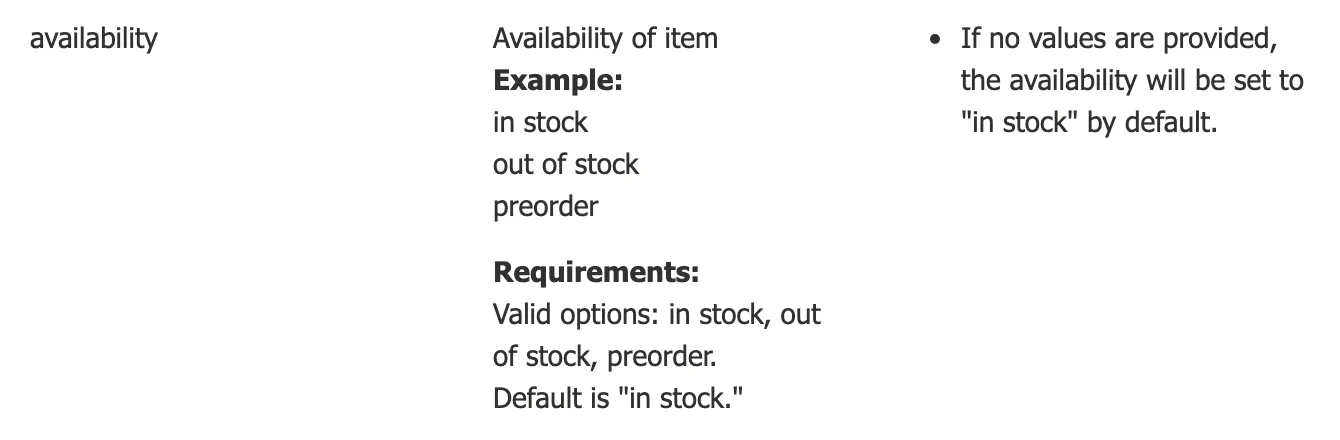
availability and condition are optional on Microsoft3.
Blank availability means in stock, and blank condition means new.
A feed with no availability column doesn't fail; it tells Microsoft that the sold-out jacket is ready to ship.
Send both, every time.
Optional fields worth sending
| Field | Limit | Why |
|---|---|---|
item_group_id |
50 characters | Variants. Each group needs one variant attribute filled on every item3 |
product_category |
255 characters, > as the separator |
Google's taxonomy under another name |
product_type |
750 characters | Your own category path, which you can bid on |
material, pattern |
200 and 100 characters | Values may be shown to shoppers |
additional_image_link |
Up to 10 | More angles |
custom_label_0 to 4 |
100 characters, 1,000 values per label | Campaign structure |
sale_price |
Same form as price |
The struck-through price |
The UCP readiness fields
Microsoft added a block of optional fields headed "UCP readiness"3. UCP, the Universal Commerce Protocol, is how an agent such as Copilot completes a checkout with a merchant4.
| Field | Limit | What it's for |
|---|---|---|
return_policy_labels |
50 characters per string | Your returns policy, with one exception policy allowed |
consumer_message_type |
A set value, such as prop_65 |
The kind of warning: legal, safety, health |
consumer_message_content |
1,000 characters | The warning shown to the buyer before purchase |
If you don't sell to the US, you can leave these until Copilot checkout reaches you. The Copilot guide covers where it's live.
How Microsoft collects the file
Microsoft wants tab-separated text, plain or zipped, and takes XML only if it's a Google-formatted file2. The limit is 3 GB uncompressed, and 1 GB for FTP, SFTP or a URL download2. A URL download runs once every 24 hours, and it's the only method with a built-in schedule2. The Google import and the Content API5 are the other ways in.
Where it differs from Google
- Availability and condition are optional, with defaults. Google requires availability on every product.
- Shipping is required in 2 countries, against Google's 21.
- Apparel rules cover 4 countries: France, Germany, the UK and the US. Google adds Brazil and Japan.
- Values use spaces:
in stock, notin_stock, so a hand-built file can't simply reuse Google's values. idmust be unique across every feed you run in a market3, so two feeds that share a SKU collide.
What Copilot reads
Microsoft's agentic commerce page says feeds mainly enable discovery in Copilot, and UCP handles the sale6. Its help page for shoppers says the details Copilot shows depend on what the merchant provides7.
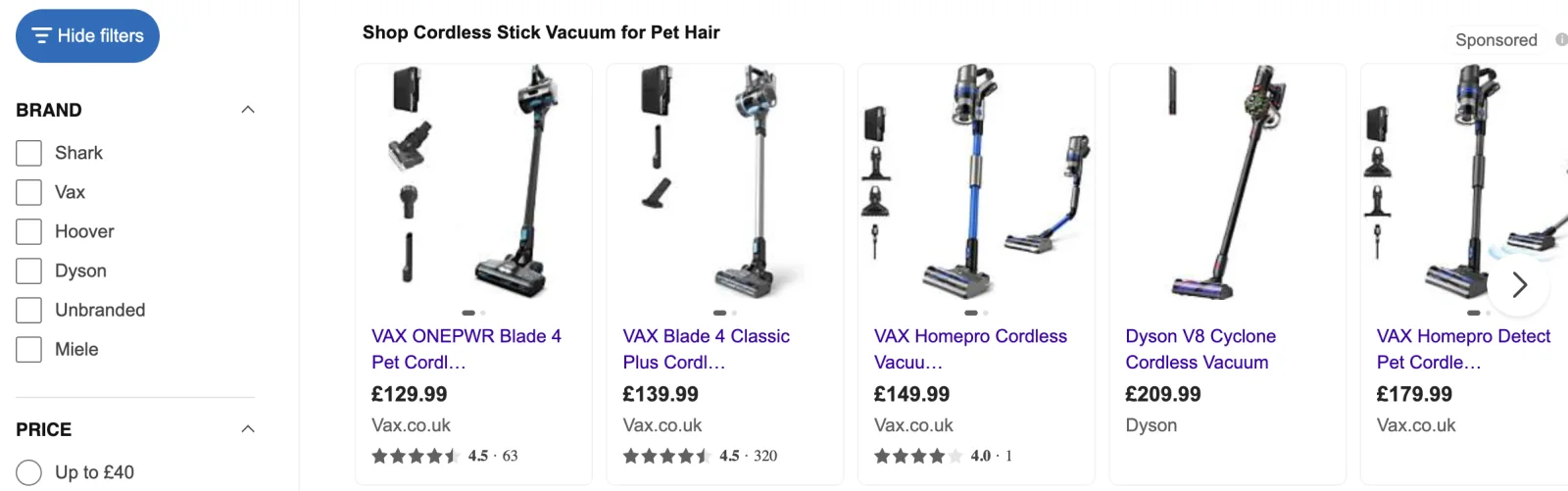
Microsoft's own title advice points the same way: put gender, size, colour, material and pattern in the title where they apply3. A Copilot question such as "quiet stick vacuum for long dog hair" matches the product that says those things, in the title or in a field. In the grid above, titles stop at about 25 characters, so most of a 150-character title is there for matching.
When Microsoft gets whatever Google got
The import is quick, and it leaves Microsoft with Google's gaps plus Microsoft's defaults.
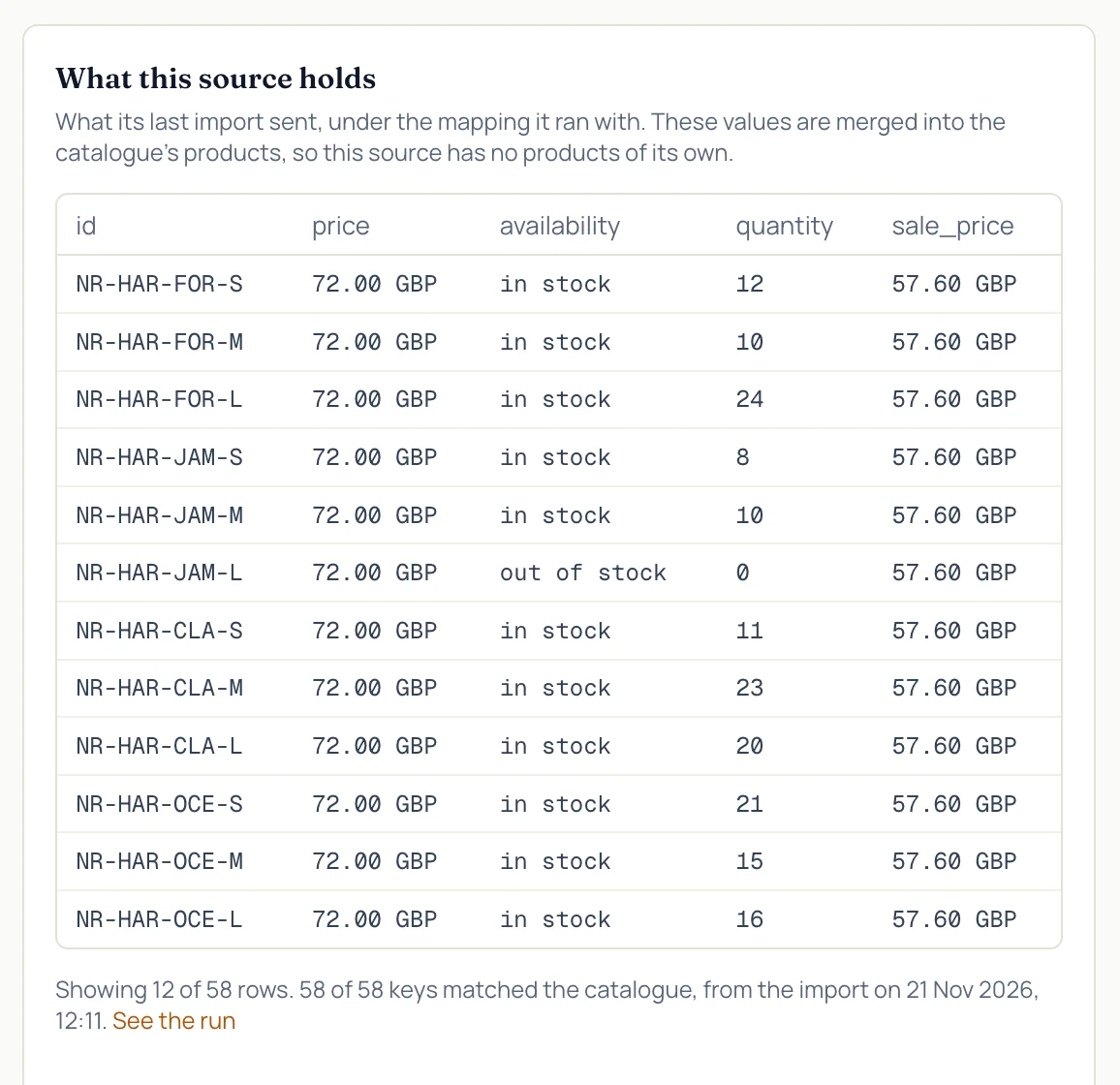
FeedWorks builds a Microsoft feed from the same product data as your Google feed, with its own mapping where Microsoft differs, so availability and condition go out on every row instead of being left to Microsoft's defaults.
It has a ready template for Copilot shopping, and shows required and recommended fields per channel before you send. Titles get rebuilt by rules Aurora drafts and you approve, previewed on the whole catalogue first. Price and stock can come in from a faster source of their own and be merged onto the catalogue before the feed is built.