Getting your products in front of Meta's Muse
Muse reads the catalogue you already keep in Commerce Manager: Meta says Muse and Meta AI can find your product data there, as well as through platforms such as Shopify and on public websites. As of 21 November 2026 there is no separate Muse feed or merchant sign-up, so the catalogue that runs your Facebook and Instagram ads is the data to fix first, and its spec already carries Meta's agentic checkout fields.
Last verified 21 November 2026. A six minute read.
Muse and the catalogue that runs your Meta ads
Muse is Meta's personal AI agent, launched in the US on 8 September 20261. It runs in its own app, at muse.ai and inside WhatsApp, and it does things as well as answering: it searches, compares, opens a browser, fills in forms and buys, stopping to ask before any purchase1.
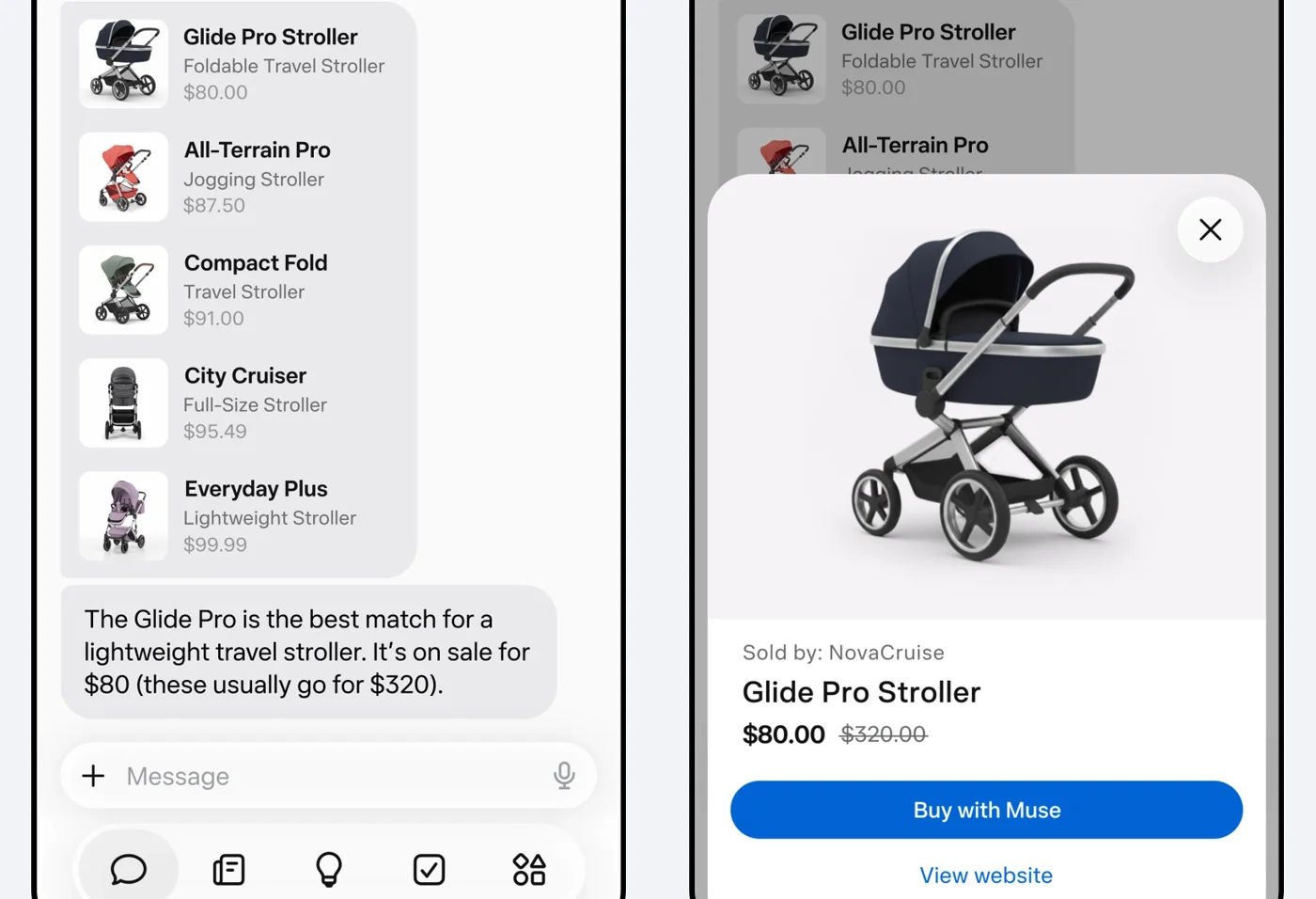
Meta's help centre names three places Muse and Meta AI find product data: your catalogue in Commerce Manager, platforms such as Shopify, and public websites16. It adds that rich, accurate catalogue data lets its AI retrieve your product details directly rather than rediscover them on the open web, and that none of it guarantees a product is shown16.
Meta's About catalogues page lists Muse and Meta AI among the things a catalogue powers17.
That catalogue lives in Commerce Manager, the one your Facebook and Instagram catalogue ads run on14, and Meta's catalogue reference now has agentic commerce fields that mark products for Direct Checkout on Meta12. Trade press reporting on one analytics firm's test suggests Muse puts well-known merchants first5.
So there's no separate Muse file to build, and the catalogue is the data to fix first. It pays off in the ads you run today as well.
How products reach Muse today
| Route | Who it's for | How sure we are |
|---|---|---|
| Your Meta catalogue | Anyone with a Commerce Manager catalogue | Documented by Meta: Muse can find your product data in it16, and it carries the agentic checkout fields12 |
| Shopify Catalog | Shopify stores | Documented by Shopify: on by default, with a Shopify checkout inside Muse2 |
| Retail connectors | Named partners such as Walmart, Best Buy, Sephora, Loblaw | Documented by Meta, partner by partner34 |
| Browsing your site | Anyone with a public product page | Meta says Muse finds product data on public websites and can open a browser and buy116. How it picks sites is unpublished |
Muse can also open a browser and buy on your site1, so your product page counts whichever route found you.
In our experience, a page that opens on the wrong variant or forces a sign-in before checkout is one an agent gives up on. Shopify notes that products can reach Meta through web crawling even with Catalog sharing turned off2, and Meta documents the crawlers that do it15. AI crawlers vs product feeds covers what a crawler gets wrong.
The Shopify toggle gets you in with your store data as it sits, the same as every other Shopify store. It doesn't put the material in its own field, fix a title that's only a style name, or mark a kids' product as kids.
Where Muse is live
| Country | Status as of 21 November 2026 | Source |
|---|---|---|
| United States | Live since 8 September | Meta1 |
| Canada | Live by 29 September | Meta6 |
| Japan | Live since 23 October | Meta Japan7 |
| Singapore | Live since 27 October | Meta8 |
| Australia | Live since 17 November | Meta9 |
| Mexico | Reported live on 5 November | Trade press, citing posts by Meta staff10. No Meta newsroom post |
| United Kingdom | Not live. Reported as coming "within weeks" | Trade press, unconfirmed by Meta11 |
Every programme by country is in AI shopping by country.
Getting your Meta catalogue ready for Muse
If you run catalogue ads on Facebook or Instagram, you already have a catalogue in Commerce Manager. It's the only structured product data Meta holds about you that you control. Most of the ones we open were set up for ads years ago, synced from the store as it was, and never looked at since.
Meta's catalogue reference asks for 9 fields before anything else12.
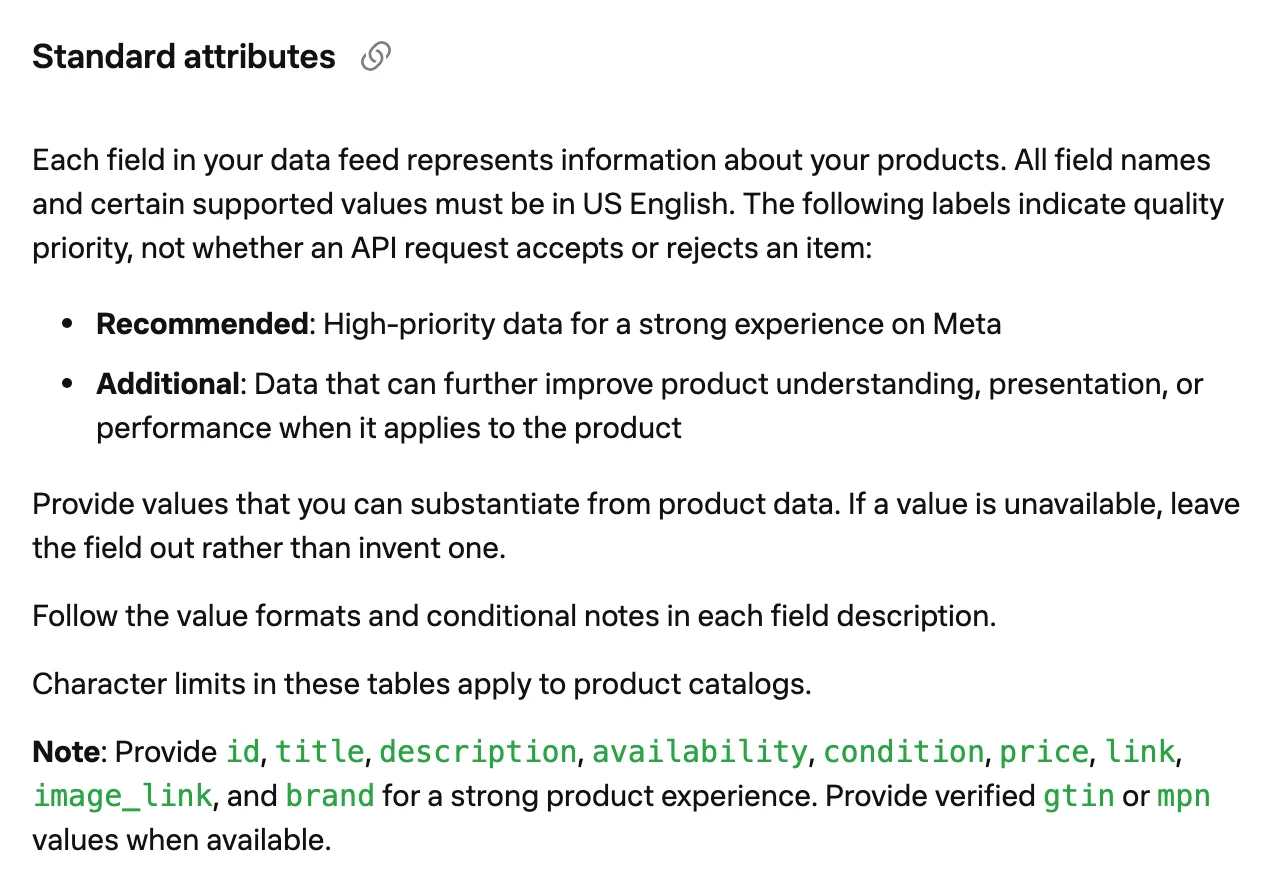
A catalogue can upload cleanly and still be weak. These are the fields we'd fix first, before disapprovals in Commerce Manager are the only thing anyone checks.
| Field | What usually goes wrong |
|---|---|
title |
A style name on its own. "The Hudson" tells an agent nothing; brand, product type, colour and size do |
description |
HTML, all caps or a copy of the title. Meta wants plain text, up to 9,999 characters12 |
price, sale_price |
Out of step with the site. Muse shows the struck-through price, so a stale sale is very visible |
availability |
Not refreshed. A product Muse can't buy is a dead end in a chat |
link |
Opens the default variant instead of the one in the row |
item_group_id, color, size |
Missing, so every variant looks like a separate product |
gtin, mpn |
Left out where the product has one |
age_group |
Set to adult, or left out, on children's products |
The agentic fields Meta has published
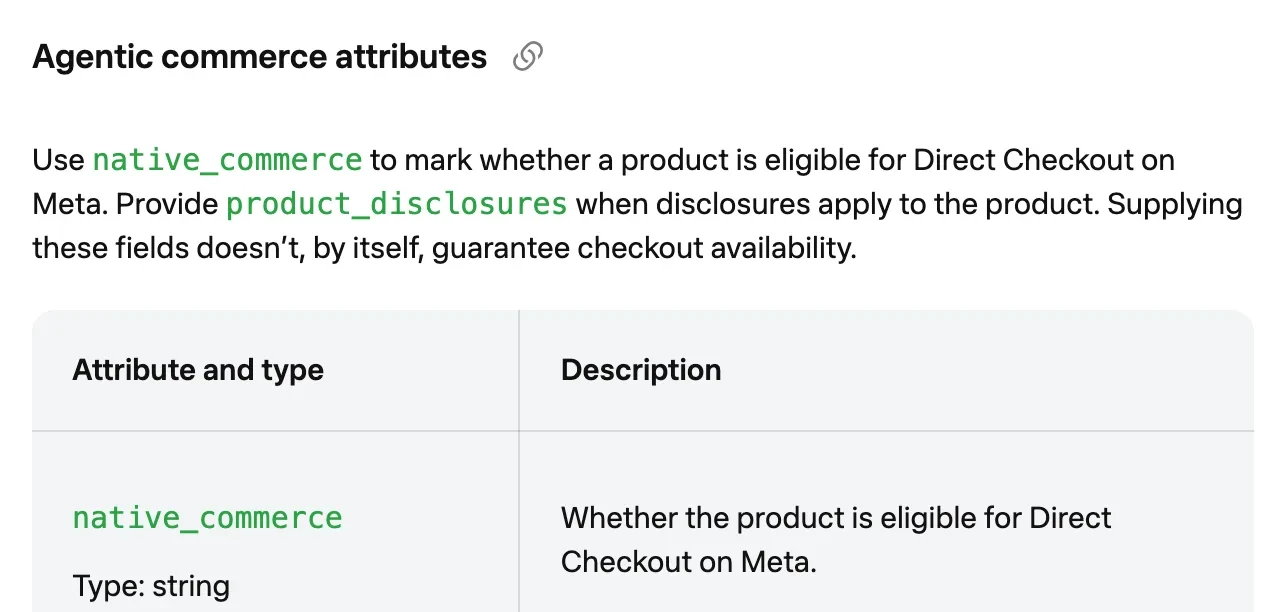
native_commerce marks a product as eligible for Direct Checkout on Meta, and product_disclosures holds any disclosures that apply to the product.
Meta says supplying them doesn't by itself guarantee checkout12.
Meta's Muse page says buying through direct checkout needs extra catalogue attributes, without naming these two16.
We'd fill them only if you're in Meta's checkout tests.
Checkout: Muse asks before it buys
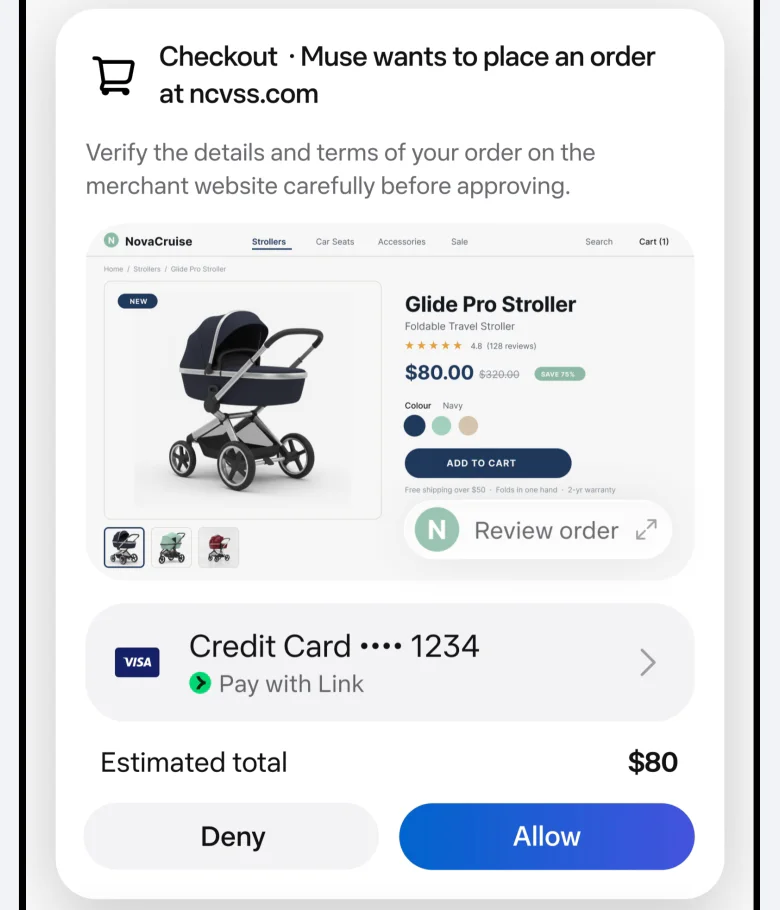
Muse pays with what the shopper connected: Link from Stripe at launch, with Shop Pay coming, Meta says1. Meta says Link hands Muse a one-time card for each purchase, so your site sees a card payment and the shopper's real card stays hidden1. In the UK, Stripe has called Link Onelink since 30 May 202618.
Meta said in October it is testing direct checkout in Meta AI with Adyen, PayPal, Shopify and Stripe13.
Shopify stores get a Shopify checkout inside Muse, on by default2. Shopify lists 11 countries for it, the UK among them, but it only works where Muse itself is live: six countries as of 21 November 2026, with Mexico known only from trade press.
You stay merchant of record, orders show under the channel "Meta AI and Muse", and Shopify charges no extra fee for it2. Subscriptions, bundles, customisable products and B2B-only products can't be sold that way, and Google Analytics and custom pixels don't fire in it2.
Meta hasn't said which checkout protocol, if any, Muse uses with merchants. How the protocols compare is in ACP vs UCP vs MCP.
When your Meta catalogue was set up for ads and left
A catalogue built for ads carries what an ad needed, and an agent answering a specific question needs more.
FeedWorks sends your Commerce Manager catalogue to Meta directly by API, from the same product data you send to Google, with only changed items between full refreshes, so a title or price you fix once reaches both. It pulls colour, material, pattern and gender out of your titles, descriptions and tags into their own fields, as rules that keep working on every new product.
Aurora finds products missing the fields Meta asks for and drafts the fix from each product's own data, and by default a person approves it. Creative Studio adds a frame or a badge to catalogue images from each product's feed data, inside Meta's image rules. What Muse does with the catalogue is up to Meta.