Shopify gets your products into the AI assistants. Getting them matched is still on you.
Shopify Catalog sends eligible products to ChatGPT, Microsoft Copilot, Google AI Mode and Gemini, and Meta's assistants, on by default. It sends your data as it sits in Shopify, so the attributes those assistants match on, often buried in tags, metafields, collections and descriptions, only arrive in their own fields if someone puts them there.
Last verified 21 November 2026. A five minute read.
Does Shopify send your products to AI assistants?
Yes, to four of them. Shopify's agentic storefronts send your products through Shopify Catalog to ChatGPT, Microsoft Copilot, Google AI Mode and Gemini, and Meta's assistants including Muse1. It's on by default for eligible stores, with nothing to install. Google's two also need your products in Merchant Center3.
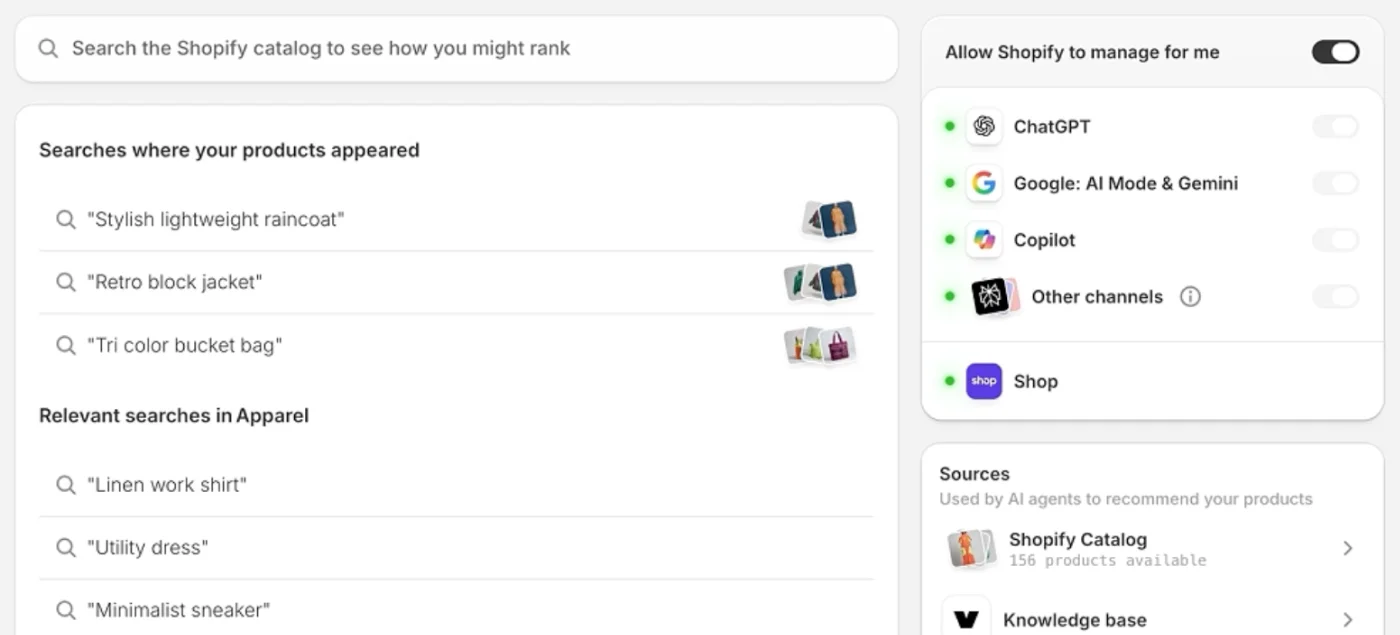
Getting there and getting picked are different things. Catalog sends the title, description, options, images, price and availability you already have10. Every other Shopify store sends the same shape of data, so being connected gives you no edge on its own. What decides whether your boot shows up for "black vegan ankle boots with a low block heel" is whether those facts are in fields the assistant can read.
What Shopify covers, as of 21 November 2026
Everything below sits under Sales channels, then Agentic, in your admin1.
| Assistant | Shoppers it reaches | How they buy | Needs |
|---|---|---|---|
| ChatGPT | People in the US2 | On your own checkout, opened inside ChatGPT2 | Catalog eligibility |
| Google AI Mode and Gemini | US, Canada, Australia3 | In the chat, where direct checkout is live; otherwise on your site3 | Catalog eligibility and a valid Merchant Center account3 |
| Microsoft Copilot | People in the US4 | In the chat, for US shoppers4 | Catalog eligibility |
| Meta, including Muse | Muse is live in the US, Canada, Japan, Singapore and Australia1113161718 | In the chat where direct checkout is live, which Shopify lists in 11 countries including the UK5; otherwise on your site | Catalog eligibility |
Your store can be based anywhere; what counts is where your customers are23. Shopify charges nothing extra for ChatGPT or Meta beyond payment processing25.
Leave Shopify to manage it and you're enrolled in each new assistant as it's added6, which is how every eligible store landed in Meta's on 8 September7. Switching one off can take up to 7 days, and products can still turn up through ordinary web crawling2.
If a product isn't going out, check Shopify Catalog's requirements. Plans below Starter, password-protected stores, B2B-only stores, products with no title, image or price, and 17 excluded categories all drop out9. Uncategorized is one of those categories, and Shopify classifies products from their own text9, so a thin description can quietly take a product out.
Where your attributes live in Shopify
We asked ChatGPT for black vegan boots with a low block heel.
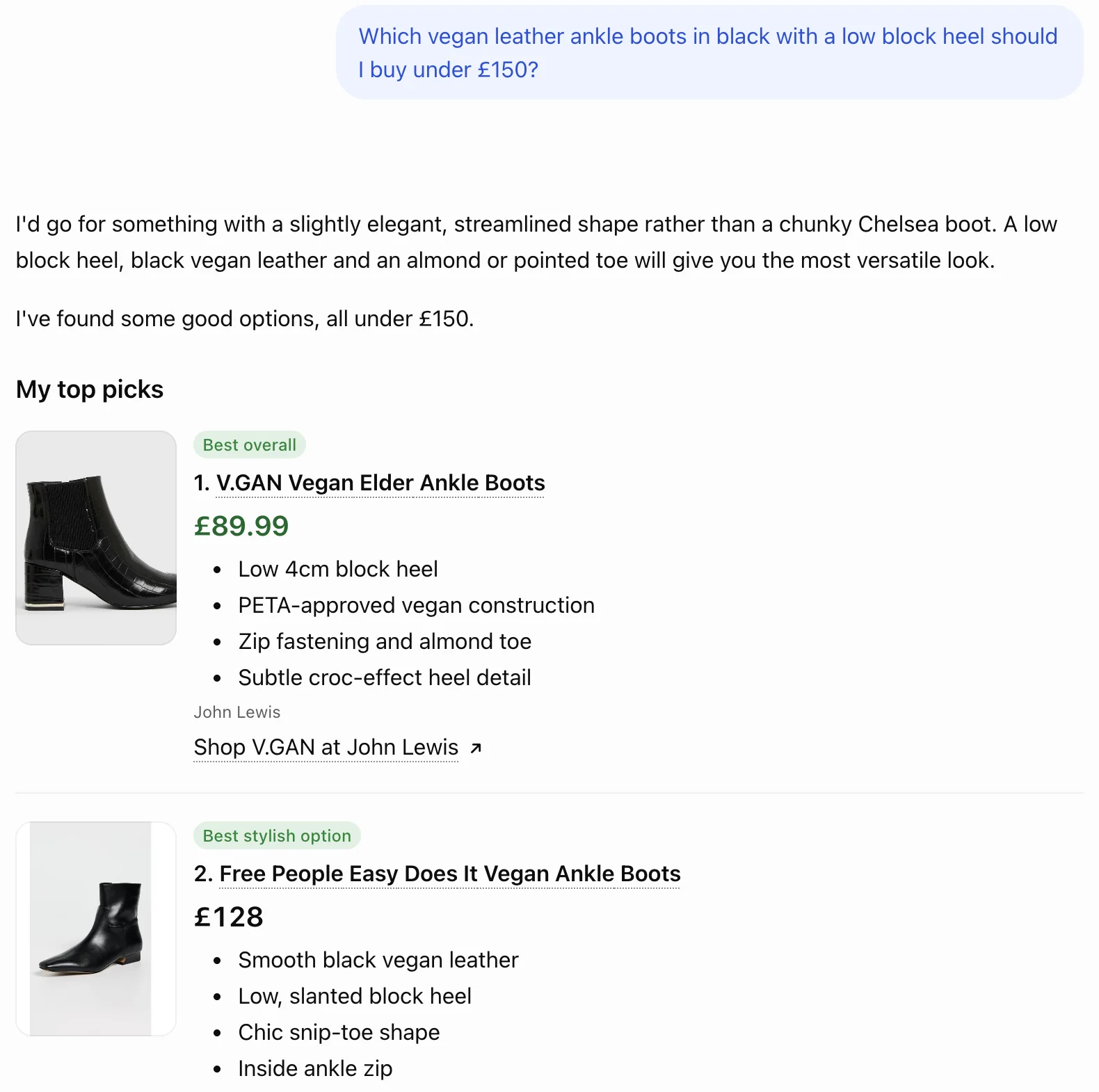
Every bullet there is an attribute. In most Shopify stores we open, those facts exist, just not anywhere a channel looks.
- Tags carry the most:
vegan,block-heel,wide-fit,gift-for-her. They're free text, one list per product, and no two stores use the same words. - Metafields hold the rest, defined by whichever theme or app added them, with names like
custom.heel_heightthat mean nothing outside your store. - Collections say who it's for and what it is, "Women's boots" or "Vegan edit", but a collection is a list of products, not a value on each one.
- Descriptions hold material, fit and care in sentences.
Shopify's category metafields, the attributes in its standard product taxonomy, are the closest thing to proper fields8, and most catalogues we see have them half filled.
What Shopify gives you to fix it
Shopify does help. Its Channel mapping page lets you point Catalog at metafields, metaobjects, tag prefixes or title delimiters instead of the defaults10. The Agentic page scores listings and shows which products could appear for a query6. Use both.
Mapping works when your data is already tidy, a tag written heel:low-block on every product, say.
It can't read "vegan" out of a sentence, decide that "Jnr" in a title means kids, or apply what you worked out last month to the 300 products you add next month.
Most feed apps on Shopify copy the same fields across, or need a rule built by hand for each attribute, in our experience.
And what each channel wants differs. ChatGPT's feed14, Google's conversational attributes and Meta's catalogue name and format the same fact differently, so one mapping inside Shopify serves all of them the same way.
What Shopify leaves to you
Google Shopping ads, Meta ads, TikTok, Pinterest and Microsoft Shopping each run on their own feed. AI Mode and Gemini read your Merchant Center feed, and Shopify says that can come from its Google & YouTube channel, a feed provider or a manual upload3. So whatever you send Merchant Center is what Google's assistants read.
Shopify reports sales, orders and sessions by assistant61215. In Copilot's and Meta's checkouts, Google Analytics and custom pixels don't fire45, so if your attribution lives in GA4, those sales arrive without the trail you're used to.
If your best attributes are stuck in tags
Moving years of tags and sentences into proper fields by hand, then doing it again for every new product, is the job most Shopify teams never finish.
FeedWorks imports your Shopify store, metafields, tags, collections and all, and drafts rules that pull colour, material, pattern and product type out of titles, descriptions and tags, and gender from collections, titles and product type. Each value is standardised to what the channel expects.
You approve the rules once and they run on every product you import after that, and where a rule can't decide, a language model reads the catalogue at the next feed build.
It doesn't change what Shopify Catalog sends, so for the Shopify route itself, fix the source in Shopify. What FeedWorks does send is its own feeds: Google Merchant Center, which AI Mode and Gemini read, and Meta's catalogue, both direct. For ChatGPT, Perplexity and Copilot it builds the feed file to each one's template, with the required and optional fields filled, and you submit it.